The Potential Role of Liquefied Natural Gas (LNG) in Producing Cleaner Energy

Submitted by kiakiagas on

Introduction

Combating climate change involves a drastic change in the patterns of energy production and consumption that does not interfere with the quality of life and economic growth. The Sustainable Development Goals (SDGs) have also been placed on the agenda to include access to affordable, secure and sustainable resources. SDGs emphasize that access to energy must be established by the use of non-conventional emerging energy sources in an economically viable and environmentally sustainable manner. Energy has been a key driver of social and economic growth, helping to alleviate hunger, increase food production and access to clean water, improving public health and education, creating economic opportunities for young people and empowering women. Around the same time, the availability of electricity from conventional fossil fuel sources has raised the amount of pollution in the atmosphere exponentially.


As a way to mitigate the adverse effects of climate change, low-carbon energy policies have been proposed. A better quality of life depends on access to energy from natural gas, and a portion of the world's population do not have access to modern energy services. Across the globe, energy demand and supply are not consistent. Consequently, each region is striving to source for cleaner energy in order to increase the quality of life instead of contributing to global warming with the use of dirty energy. An example of this is the option of natural gas as a fuel to ensure a smooth transition to a sustainable world of energy. The earth has large amounts of natural gas, but most of it is in places far from where the gas is required. Natural gas must be converted into liquefied natural gas (LNG) so as to be able to transport this cleaner-burning fuel through oceans, a process called liquefaction. This has changed with the introduction of floating storage and regasification units (FSRUs), which are basically floating terminals for the LNG. This article attempts to assess the possible roles of LNG in generating cleaner energy for electricity and transport.


Liquefied Natural Gas (LNG)

According to the Britannica (2020) LNG is a natural gas (NG) that has been liquefied for ease of storing and transporting which is 600 times smaller than natural gas when it is in its gaseous form, and it can be easily shipped overseas. LNG is produced by cooling natural gas below its boiling point, −162 °C (−259 °F), and is stored in double-walled cryogenic containers at or slightly above atmospheric pressure. By merely increasing the temperature, it can be transformed back to its gaseous state. Aside from Angola, Equatorial Guinea, and Cameroon, Nigeria is one of the countries blessed with LNG in Sub-Saharan Africa.


Roles of LNG in Providing Cleaner Energy

The role of LNG has been largely positive over the last two decades. LNG has contributed to reducing carbon emissions and provided reliable support and back-up for renewable energy. Two of the biggest decarbonizers on an absolute and relative basis are the United States and the United Kingdom. They have dramatically reduced their coal burnt in the power generation sector while greatly increasing the penetration of natural gas. In the United Kingdom, a modest carbon tax has been adopted to essentially eliminate coal from the country’s power generation mix. The United States has no carbon tax, but the shale gas revolution has lowered the cost of natural gas to a level that leaves many coal-fired power plants unable to compete. In Europe and Korea, despite the occasional policy inconsistency, trends are in a similar direction—the combination of renewables and natural gas is pushing coal out of the mix. Emerging markets have embraced natural gas as a power generation fuel but rarely as a strategic component of a clean energy mix. China has increased her purchases of LNG over time. The purpose of Chinese LNG purchases has been to improve air quality in northern China, an effort that has been stunningly successful and is expected to continue for some time. China’s LNG binge has contributed directly to increased confidence among LNG project sponsors, and that confidence translates, in part, to positive investment decisions for new capacity.


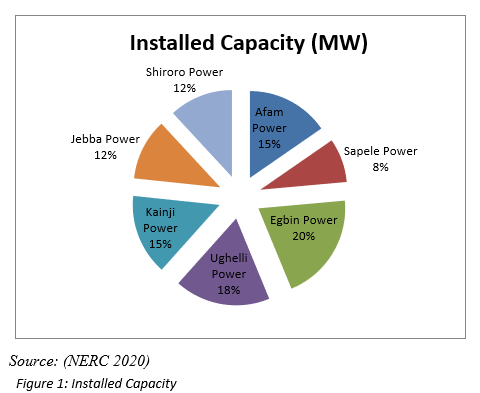
According to USAID (2020), Nigeria is the largest economy in sub-Saharan Africa. It is also endowed with large oil and gas deposits, and huge potentials for hydro and solar energy. As demand for local consumption of gas intensifies, especially for gas-to-power, Nigeria may take advantage of the low prices to increase power generation. Uninterrupted power supply through the use of LNG will bring about a functional industrial hub. According to the Nigeria Electricity Regulation Commission (2020) the six power generation plants of Afam, Sapele, Egbin, Ughelli, Kainji, Jebba and Shiroro generated a total of 5048 Megawatt (figure 1).
 

Compared to hydro and other dirty resources, LNG is a more cost-effective approach to generating electricity, even when power is used flexibly, there would be space for use in other domestic activities such as cooking, lighting and heating. Holding the LNG option open as an alternative to the dirty energy would provide scope for innovation in order to increase the nation's ability to generate more electricity to light more homes and power factories. In addition to advances in vehicle performance, LNG could form a bigger part of the transport energy mix as a lower-carbon fuel. In contrast to diesel, kerosene and fuel oil, the use of LNG is being exploited as a transport fuel for trucks and vessels with possible economic and environmental benefits. In contrast to diesel, kerosene and fuel oil, the use of LNG is being exploited as a transport fuel for trucks and vessels with possible economic and environmental benefits. The environmental performance in terms of CO2 emissions and the availability of abundant natural gas reserves make it a potentially viable alternative fuel while it has lower energy content than diesel in terms of volume.


LNG can reduce problems of poor air quality when used in power generation, as an industrial fuel and as a transportation fuel. While Compressed Natural Gas (CNG) is used in passenger and return-to-base commercial vehicles, Liquefied Natural Gas (LNG) also presents a cleaner alternative to the use of oil products for heavy-vehicle road and marine (inland) transport. LNG has contributed to reducing carbon emissions and provided reliable support when combined with renewable energy. This combination can be delivered as integrated solutions for centralized energy systems as well as for decentralized systems, for example, for the residential market, where solar applications are becoming increasingly available. On these grounds, natural gas can act as a companion fuel to renewable and play a key role in the transition to a low-carbon energy system.


Conclusion

As gas-fired generation emits half the CO2 of coal-fired generation, the contribution that gas could make towards a low-carbon environment is thus substantial. Natural gas has proven its carbon advantage relative to coal, and as developed countries have shown, natural gas can have an immediate impact in reducing local pollution; these benefits should be incorporated in policy frameworks. To meet the growing demand for power generation, transmission and distribution, as well as means of transportation as the world, tries to tackle emissions, power plants and vehicles with the use of cleaner liquefied natural gas energy would be required. LNG has the potential to give fuel cost savings compared to traditional diesel and premium engine.
PERTAINING SOLAR ENERGY

Submitted by kiakiagas on

Currently, 50% of Germany’s net electricity is generated from solar energy. Harnessing solar energy to generate electricity is becoming more mainstream as the world moves towards a green future. The International Energy Agency projects that Solar Photo-Voltaic would be the most installed power generation capacity by source by 2040. Solar is slowly being adopted around the world, due to its zero emissions of harmful substances during operation. It is necessary to examine how solar energy is harnessed and the current efficiencies.

Solar energy refers to energy harnessed from the sun. The sun gives off light and heat and these can be harnessed for different activities i.e. the light or heat from the sun can be harnessed for power. Solar energy has been harnessed since 7th Century B.C. where magnifying glasses were first used to concentrate the sun’s rays to make fire (and burn ants). As time passed, the technology improved with Roman bathhouses constructed to have large south facing windows which let the sun’s warmth into the designated area, between the 

1st to 4th Century A.D. There have been a large number of historical inventions and innovations aimed at harnessing the sun’s energy to meet human needs, and there will be more of such.

This article will focus on solar energy harnessed to cook food and to produce electricity. The solar collector was invented in 1767, which was later used to cook food in the 1830s. This was relatively earlier than the discovery of the photovoltaic effect in 1839. These technologies have greatly improved in the last century and this article shall examine their operations.


Solar Energy for Producing Electricity

How the Photovoltaic Cell Works

 Solar photovoltaic conversion is the conversion of sunlight into electricity. Photovoltaic (PV) cells react to light by turning part of it into electricity. Silicon is the most used PV cell material, for this reason a lot of research has gone into silicon as a way of understanding PV cells. When light strikes a silicon crystal, it is either reflected, absorbed or goes right through the crystal. Absorbed light (of great energy) upon striking the silicon crystal causes electrons to separate from their bonds. These free electrons are the means by which electricity flows.   The electrons are acted upon by a (built-in) potential barrier which causes the electrons to produce a voltage used to drive a current through the circuit. The potential barrier can be created by doping the PV material, i.e. adding an impurity in order to aid electron movement. In 1960, solar cells were 5% efficient, but recent solar cells are 24% efficient, although the majority of solar panels are below 20% efficient.


Photovoltaic System Set-up 

There are certain considerations necessary to effectively install a PV system. PV modules (collection of solar cells) need to be mounted where there is direct access to sunlight. PV modules are usually mounted on roofs but can be mounted on the ground as well. It is also necessary to ensure that there is no shading around as even the shadow of a single branch of a

leafless tree can significantly reduce the power output of a solar module. PV modules are conventionally oriented towards the true south but would also work fine (with less efficiency) if on a roof facing east or west. Solar modules (specifically stationary modules) also have to be tilted plus or minus 15° with respect to that location’s geographic latitude, based on the time of the year.

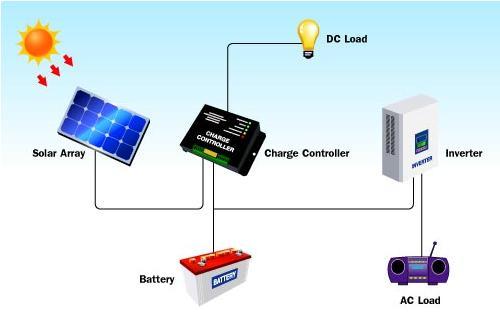
The flow of energy in a stand-alone Photovoltaic system goes thus:

  1. Solar Modules (Panel): here, the light rays are converted to electricity.
  2. Charge Controller: also referred to as battery charger. Its primary function is the prevention of the overcharging of batteries, which eventually damages them. It regulates the power going into the battery from the solar panels and cuts off excess power. It is necessary for off-grid solar PV systems; in grid-connected systems, excess power goes into the grid.
  3. Battery: batteries store direct current (DC) energy for later use.       The batteries store energy for use after the solar panels are not receiving sunlight. Types of batteries include Lithium-ion batteries and Lead Acid batteries.
  4. Inverter: the inverter converts DC to Alternating Current (AC). The AC is used to run appliances in the building.


Figure 1. Photovoltaic System Energy Flow

Source: Silver Solar Batteries.


Cost Considerations between Photovoltaic System and Natural Gas as Household Energy Source

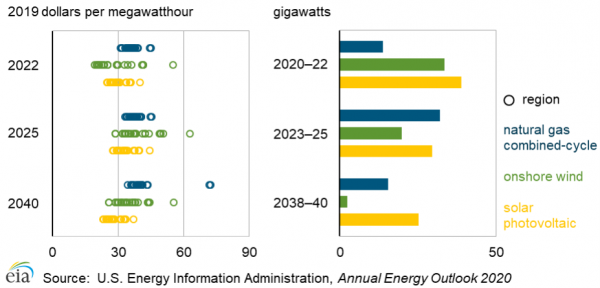
The major challenge with the solar PV system is the cost of installation. There are no (or very negligible, if any) operating costs involved in using PV systems, yet it is currently the most expensive source of electricity. This is due to the cost of equipment needed to set up a PV system.  Producing electricity through natural gas is still the cheapest. The Energy Information Administration (EIA) predicts that electricity generated via natural gas combined-cycle will remain cheaper than electricity generated from solar photovoltaic systems. This is ascertained by taking into factor the capital and operating costs of both methods of producing electricity of a period of time.


Figure 2. Compared Cost of Generating Electricity.


Household Cooking Energy: Solar Energy vs Liquefied Petroleum Gas

Cooking with solar energy is done by harnessing the thermal energy coming from the sun. Solar cookers simply concentrate the heat from the sun towards the cooking spot. Some homes powered by solar PV modules use electric cookers; hence, by extension, they cook by means of solar energy. This (indirect) method of cooking with solar energy is not considered in this article. There are about 4 basic methods of using solar energy to cook food. They are:

  1. The parabolic solar cooker: this uses curved concentrators (parabolic-shaped reflectors)to direct the sun rays to the base of the oven; thus creating a region of high heat concentration. The food (pot) is placed at the base to be heated. They can reach temperatures as high as 350°c, making it good for grilling and frying.
  2. The box solar cooker: these are the most common around the world. The box retains the heat from the sun and as the temperature in the box increases, the pot is heated up and the food is cooked. The box solar cooker can reach temperatures as high as 204°c.
  3. The evacuated tube solar cooker: these are fairly new solar cookers. It is made from a large evacuated glass tube which is surrounded by reflector panels. The glass tube can reach temperatures of 290°C. The cooker can be used to cook meat, bread, or vegetables.


Solar cookers are still a work in progress. They take too long to cook meals, sometimes 2 hours longer than firewood. Solar cookers are relatively expensive. A search on Amazon.com showed the cheapest solar cooker costs over $70. This is unattractive as it is limited in efficiency as well as availability. One would not be able to cook with a solar cooker once the sun is not out i.e. solar cookers cannot be used during the early morning or night, or during rainfall. To this end, Cooking gas(Liquefied Petroleum Gas) is still the best bet as it is far cheaper then solar cookers and is independent of the weather.


The technology used to harness the sun’s energy keeps improving with time, and in a few decades, solar energy would be easier to harness. It is therefore necessary to consider natural gas as an available, cheap and efficient source of energy. Natural gas provides relatively cheap electricity, and Liquefied Petroleum Gas (a by-product of natural gas processing) is a relatively cheap fuel for cooking. It is imperative that while renewable energy sources are being developed, natural gas (and its products) are used as a bridge to the fully green future.

 
KiakiaGas Limited is a leading Gas business in Lagos,Nigeria with expertise in LPG retailing, New Gas Market development, Building of Gas Plants and Gas strategy advisory.
If you need a partner with hands-on local expertise in the Nigerian Gas space or any of our bespoke solutions/services, write us at gaspreneur@kiakiagas.com or call/Whatsapp: +2348085269328 

Subscribe to electricity