


Introduction
As the world continues to clamour for a more environmentally friendly source, Liquefied natural gas (LNG) a form of Natural gas has continued to receive more and more attention due to its very low carbon emissions and energy density. LNG is natural gas cooled to extremely low temperatures as low as negative 160 degrees Celsius. At this temperature it occupies about 600 of the same volume occupied by natural gas with the same specific energy. This allows LNG to serve as a more viable method for the bulk transportation of Natural Gas over long distances usually by sea faring vessels. World demand for natural gas is on the increase as every year more and more energy is required, the, International Gas Union (IGU ) 2017 LNG Report forecasts a global 45% increase in demand for natural gas from 2015 to 2040 and expects worldwide trade of LNG to increase by a factor of 2.5 within the same time period.
LNG Value chain
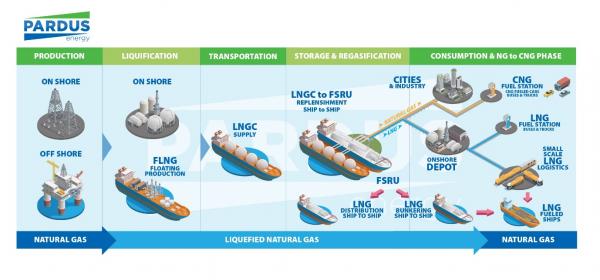
The process chain of LNG supply includes :-
Exploration &Production : This involves all upstream activities pertaining to the survey, discovery, and extraction of natural gas, either from natural gas deposits or from other sources like shale and crude oil extraction.
Liquefaction : Here impurities such as dust, water and other heavy hydrocarbons are removed and the gas is then cooled to -160oC at normal atmospheric pressure which condenses it to a liquid.
Transportation: Here large sea tankers or Liquefied natural gas carries or LNGC take the liquefied product over long distances for commercial purposes. The capacity of the vessels can range from as low as 40,000m3 to 172,600 m3 of LNG ( the capacity of the Christophe de Margerie a Russian ship capable of supplying the entire Natural gas consumption of Sweden for a month).
Storage and regasification: This is a midstream process where the LNG is off loaded from the LNGC’s and prepared to be transported to resale points in 3 forms, either still as LNG or is expanded and converted back to Natural Gas for pipe-line distribution or compressed as CNG for easy transport by Tanker trucks. To accomplish this two methodologies currently exist either traditional LNG Terminals and more recently Floating storage and regasification units (FSRUs).
End use: At this stage, the processed gas is delivered to the consumer usually as CNG (compressed natural gas) in pressurised containers for all kinds of use.
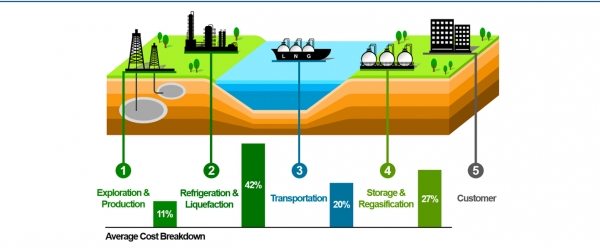
Our focus lies in the Storage and regasification stage which according to a 2017 study by Lee, Inkyu & Park, Jinwoo & Moon Il accounts for 27% of the total cost of LNG value chain roughly a fourth hence its importance and our interest.
LNG Terminals
LNG terminals are port facilities that receive, store, convert and transport Liquified Natural gas, they are typically located ashore and are built to accommodate large LNG carrier vessels. According to the IGU 2020 report as at February 2020 ,there are currently 105 terminals currently in operation worldwide with a further 14 planned to begin operation within the next 2 years.
There are two types of LNG terminals based on their function namely Regasification & Liquefaction terminals respectively
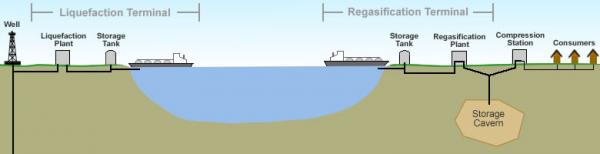
Liquefaction terminals
These refer to terminals that receive pumped Liquified Natural Gas from Liquefaction plants (which are mostly situated close to the source of gas so as to reduce complexity and cost) through pipelines after which it is then stored in specialised storage tanks while awaiting transport to ships for export.
Regasification terminals
This are terminals that receive imported natural gas from ocean tankers, store it temporarily and then send it to a Regasification facility or directly to tanker trucks for transport as LNG. At the regasification plant the LNG is then converted to CNG or natural gas and distributed using pipe-line
networks or land based transport, any additional gas is then stored using specialised underground storage tanks.
Advantages
Some of the advantages of traditional LNG terminals include.
Immense Capacity:
Perhaps the biggest factor to consider is that Terminals are built to process large volumes of Natural gas daily and they do this effectively with small terminal capacity ranging from 100,000 m3 to large terminals that can house millions of cubic feet of natural gas conveniently.
Scalability:
Another huge advantage is that traditional terminals can be easily expanded provided the required land area is available. An example is the expansion of the Nigerian LNG project at Bonny island to add a seventh LNG processing unit to increase its total production capacity from 22 million tonnes per annum (Mtpa) to 30Mtpa, and the LNG terminal expansion by Polskie LNG in Poland to increase regasification capacity of the terminal to 7.5 billion Nm3/year and build a second jetty for loading and unloading of LNG Vessels.
Long Service life:
Generally Terminals are built to last at least 25 years and more with proper maintenance their service life can even be extended without risking or compromising safety standards. A notable example is the Chita LNG terminal in japan which was commissioned in 1983 and is still running today.
Disadvantages
Huge cost:
LNG terminals are not cheap as they can cost upwards of 1 billion dollars in investments, they also come with huge upfront costs and are generally considered a long term investments as they take years to breakeven or show Return on Investment.
Land requirement:
LNG terminals require huge swathes of land due to the scope of activities needed to load and offload LNG from vessels, they require a jetty or harbour, a lot of surface area for the storage tanks and regasification plants as well as proper segmentation for health and safety standards.
Time of construction:
Typically LNG terminals can take anywhere from Four to six years In construction, take for example South Hook’s LNG terminal located in Milford Haven UK, Europe’s largest LNG terminal, construction began in 2004 with over 2500 workers and was commissioned in 2009.
FRSU vessels
Floating storage and regasification units (FSRUs) are sea vessels that offer both transportation and conversion of LNG to other forms simultaneously. First developed in 2005 by transforming an already existing LNGC vessel, FRSU’s are a smaller and cheaper method of supplying Natural to small and medium markets. FRSU’s are made up of
Storage Tanks: usually membrane or spherical Moss type tanks
Regasification unit: which converts the LNG back to natural gas by slowly heating the liquid under atmospheric pressure. Generally sea water is used except when travelling through colder regions in which case, steam from the ships boiler is used.
LNG Unloading Arms or Hoses: These are used to receive and offload the cargo to and from the FRSU which is usually transferred ship to ship. The primary advantage of hoses over unloading arms is that its cheaper and less bulky with the latter being faster in operation and easier to manoeuvre.
FRSU’s are either newly constructed or made by refurbishing already existing LNG carries and generally consists of two types as FRSU ships or offshore installations.
FRSU ships: These are vessels that are able to transport and convert LNG simultaneously and posses their own propulsion systems. They are similar to other sea faring vessels and can dock in ports and harbours
Offshore installations: these are barge like facilities that can be moored offshore their primary advantage is greater capacity than their counterparts.
According to the IGU 2020 report as there are currently 25 FRSU vessels worldwide and a further 14 vessels to be deployed in by 2021.
Advantages
Speed of deployment:
Unlike Classical terminals which take at least 5 years of construction, FRSU’s can be built and deployed under 2 years. Case in point is the FRSU Independence in South Korea for which construction started in 2012 and operations began operations in 2014.
Flexibility:
The mobility of FRSU vessels allow flexibility in delivering Natural Gas to new markets as well as allowing for a collapsed model of operations.
Cheaper option:
They are also cheaper to build for instance the Independence construction cost was 330 million dollars a sharp contrast to the construction cost of 1 billion pounds (1.4 billion dollars). The cost is further driven down if the FRSU is constructed from a refurbished LNGC.
Disadvantages
Limited capacity:
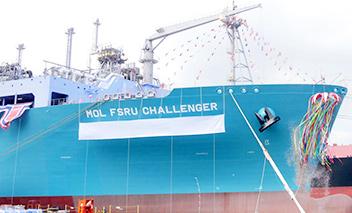
FSRU’s have a somewhat limited capacity compared to traditional terminals. For example the Korean FRSU the Challenger with a storage capacity of 263,000 cubic meters lacks in capacity when compared with traditional LNG terminals like the Arun LNG Plant, a medium sized LNG terminal in Indonesia with a storage capacity of 630,000 cubic meters. FRSU’s cant also be upgraded as easily as Traditional LNG terminals who are only limited by the available land area.
Short Life span:
FRSU generally last anywhere from 10 to 15 years of operations pending proper maintenance and overhauling repairs however this adds to the overhead operational cost.
Comparing FRSU and LNG terminals
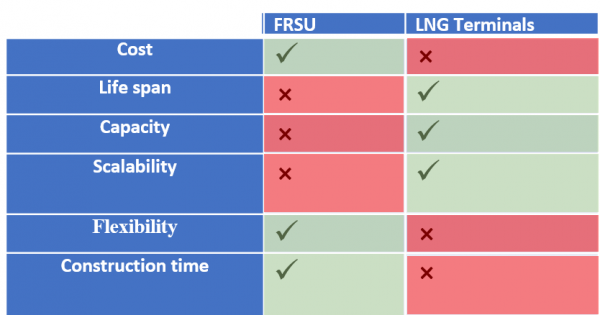
A quick recap of the benefits of the FRSU and LNG terminals
Conclusion
To say one method is better than the other would do them both injustice. Both have their place and can even be used complementarily. An example can be seen in the US where during harsh winters when demand for Natural Gas peaks , FRSU vessels where used to supplement the supply of LNG normally obtained from shale gas field. There are several factors that influence the choice to make between adopting LNG or FRSU facilities namely life span, capacity cost, reliability and market size. When considering large markets such as China , US and South Korea it is more economical to build Terminals when considering the market size however in smaller newer markets that aren’t LNG dependent FRSU vessels may be the viable choice.
KiakiaGas Limited is a leading Gas business in Lagos,Nigeria with expertise in LPG retailing, New Gas Market development, Building of Gas Plants and Gas strategy advisory.
If you need a partner with hands-on local expertise in the Nigerian Gas space or any of our bespoke solutions/services, write us at gaspreneur@kiakiagas.com or call/Whatsapp: +2348085269328