


Introduction
The African Continental Free Trade Area (AfCFTA) agreement is made up of 54 African countries merging into a single market of 1.3 billion people. With the benefit of developing sustainable markets, this resource could create an economic bloc with a combined GDP of $3.4 trillion. Intra-African trade is projected to rise by 33 percent once in operation and Africa's overall trade deficit is expected to be halved. Furthermore, by 2030, the AfCFTA could generate $6.7 trillion in combined consumer and business spending. Trading is expected to begin on 1 January 2021 under the AfCFTA. Not only is AfCFTA a free trade agreement, it is a tool for the economic transition of Africa. It will promote the movement of individuals and labor, competition, investment and intellectual property through its different protocols. According to the World Bank, it is estimated that the AfCFTA could boost regional income by 7% or $450 billion, speed up wage growth for women, and lift 30 million people out of extreme poverty by 2035. This could be achieved through existing human and natural resources endowment in Africa, most especially the oil and gas resources that are channeled majorly to the western and eastern part of the world.
Africa has considerable oil and gas resources that can help accelerate growth on the continent if used strategically. The African continent is home to five of the world's top 30 oil producing countries. In 2019, it accounted for over 7.9 million barrels per day, which is about 9.6 percent of world production. This production level has fallen considerably from the peaks of 2005 to 2010, when African production amounted to almost 10 million barrels a day. While new resources are increasingly being found, they are not distributed equally; indeed, 38 African countries are currently net importers of oil. Since last year, Africa's share of global oil production has marginally increased by 0.3% to 8.7%, standing at 8.1 million bbl/d. Nigeria, Angola, Algeria, and Egypt continue to be significant contributors. In 2017, Libya doubled production, promoting it with an 11 percent share to the fourth largest oil producer in Africa, bringing Egypt into fifth place. At the end of 2017, Africa was estimated to have 487.8 tcf of proven gas reserves, unchanged at 7.1 percent of proven global reserves. Two major gas discoveries by Kosmos Energy added an additional 1.5 billion BOE of gas to their portfolio in the Senegal-Mauritania basin. According to Kosmos and joint venture partner BP, the Yakaar discovery, combined with the Teranga discovery in 2015, provides the basis for another LNG center in the basin. Most of the big oil production declines between 2010 and 2015 are attributed to lower global oil prices. Production between 2015 and 2019 has stabilized. However, the pandemic of the Corona virus and a production dispute between Saudi Arabia and Russia drastically lowered oil prices in early 2020. As a consequence, as of June, potential oil output trends in Africa and around the world were highly uncertain.
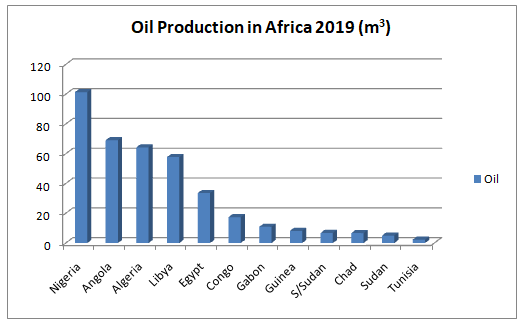
Source: Statista 2021
The Corona Virus Disease 2019 (COVID-19) is a communicable respiratory disease caused by a new strain of COVID-19 that causes illness in humans. Scientists are still learning about the disease, and believe that in animals, the virus originated. The disease spreads by contaminated air droplets, which are projected during sneezing or coughing, from individual to individual. It may also be transmitted when humans come into contact with hands or surfaces containing the virus, and when infected hands touch their eyes, nose, or mouth. In China, COVID-19 was first published, but it has now spread worldwide and Africa is no exception.
The novel COVID-19 strains the health systems, education, aviation, culture, commerce, and general livelihoods of Africa as well as the public and private sectors of the continent in the midst of lockdowns, stifling income streams. The International Monetary Fund has revised the continent's GDP growth projection from 5.1% before the pandemic to -1.6%. Similarly, from 2.4% in 2019 to between -2.1% and -5.1% in 2020, the World Bank has projected a similar decrease. Compared to other countries, on the one hand, mortality from the pandemic has been very low, but the economic impact would be immense. These reports signal the region's first recession in the past 25 years. In times of an unprecedented health crisis, policymakers need a stimulus package as well as trade instruments, such as the AfCFTA deal, to boost economic recovery. The benefits of liberalized trade would be granted to African countries. It can serve as an alternative stimulus package for job creation, foreign exchange, industrial development and economic growth to improve intra-African trade.
Many factories in Africa have changed production because of global shortages and have revamped to produce basic protective equipment. In Ghana, one of the largest liquor manufacturing firms shifted production to manufacturing hand sanitizer, while in Kenya, in a country that barely manufactured any before the pandemic, a factory retooled to manufacture 30,000 surgical masks a day. Similarly, the Hawassa Industrial Park started the manufacture of face masks in Ethiopia to ease the rising demand due to the pandemic. In addition, their governments also encouraged factories in Morocco, Rwanda, South Africa and several others on the continent to manufacture protective equipment to prevent the virus. In South Africa where U-Mask has redirected its production from protective masks for mining and agriculture to that for medical respiratory masks, and Nigeria where the National Agency for Science and Engineering Infrastructure produced made in Nigeria ventilators.
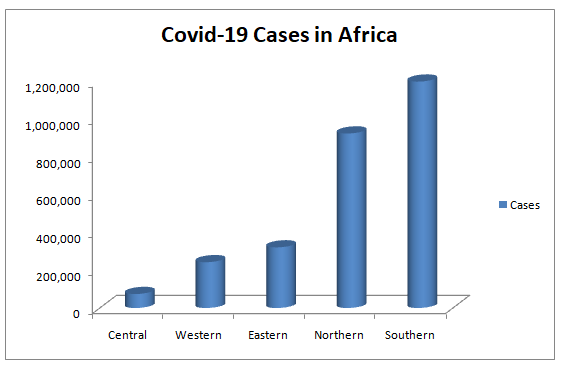
Source: AfricaCDC 2021
COVID-19 IMPACTS on Oil and Gas in Africa
In 2019, the African economy was set to expand at approximately 3.4 percent and is projected to rise to 3.9 percent in 2020, but COVID-19 had a very negative effect due to a major oil price crash. Given the global disruption of the supply chains in the major global trading countries, trade in the oil and gas sector has been especially affected. The deep reorganization of global supply chains has impacted African oil and gas operators. The Covid-19 crisis has revealed that global value chains centralized in a single area do not represent an ideal investment for governments in terms of protection, as well as risk for oil and gas companies.
Africa is also more vulnerable to the impact of Covid-19 because as more countries in Africa lock down their economies and apply movement controls, oil and gas demand was disrupted. Consumers of gas at home quickly switch to the alternative energy for cooking. They replace the liquefied petroleum gas (LPG) for firewood which is not far-fetched from their environment. This resulted into low demand and reduction in oil and gas revenue in Africa.
Conclusion
Africa's economic activities, especially the oil producing nations that export their oil and gas to developed countries, were disrupted by the Covid-19 crisis. But it also gives African countries an opportunity to fix them. For instance, by concentrating on goods of greatest need during the health crisis, they might accelerate intra-regional trade. In order to advance industrialization, develop infrastructure and enhance good governance, countries should also start building regional value chains. The acceleration of the AfCFTA is expected to be very significant in the long term for the reconfiguration of oil and gas supply chains, the establishment of regional value chains and the boosting of the production of critical value-added goods. Given this ability, the AfCFTA is being marketed as Africa's stimulus package to counter the devastating effect on African economies of the COVID-19 pandemic.