Comparing LNG Terminal and FSRU Vessels

Submitted by kiakiagas on
Introduction

As the world continues to clamour for a more environmentally friendly source, Liquefied natural gas (LNG) a form of Natural gas has continued to receive more and more attention due to its very low carbon emissions and energy density. LNG is natural gas cooled to extremely low temperatures as low as negative 160 degrees Celsius. At this temperature it occupies about 600 of the same volume occupied by natural gas with the same specific energy. This allows LNG to serve as a more viable method for the bulk transportation of Natural Gas over long distances usually by sea faring vessels. World demand for natural gas is on the increase as every year more and more energy is required, the, International Gas Union (IGU ) 2017 LNG Report forecasts a global 45% increase in demand for natural gas from 2015 to 2040 and expects worldwide trade of LNG to increase by a factor of 2.5 within the same time period.

LNG Value chain

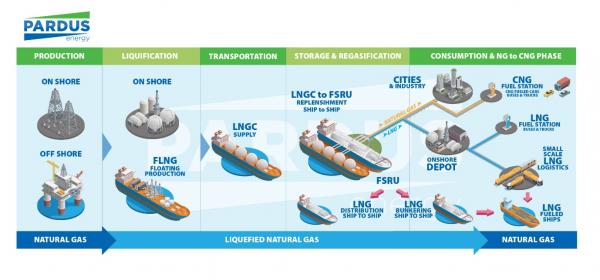
The process chain of  LNG supply includes :-

Exploration &Production : This involves all upstream activities pertaining to the survey, discovery, and extraction of natural gas, either from natural gas deposits or from other sources like shale and crude oil extraction.

Liquefaction : Here impurities such as dust, water and other heavy hydrocarbons are removed and the gas is then cooled to -160oC  at normal atmospheric pressure which condenses it to a liquid.

Transportation: Here large sea tankers or Liquefied natural gas carries or LNGC take the liquefied product over long distances for commercial purposes. The capacity of the vessels can range from as low as 40,000m3  to 172,600 m3  of LNG ( the capacity of the Christophe de Margerie a Russian ship capable of supplying the entire Natural gas consumption of Sweden for a month).

Storage and regasification: This is a midstream process where the LNG is off loaded from the LNGC’s and prepared to be transported to resale points in 3 forms, either still as LNG or is expanded and converted back to Natural Gas for pipe-line distribution or compressed as  CNG for easy transport by Tanker trucks. To accomplish this two methodologies currently exist either traditional LNG Terminals and more recently Floating storage and regasification units (FSRUs).

End use: At this stage,  the processed gas is delivered to the consumer usually as CNG (compressed natural gas) in pressurised containers for all kinds of use.

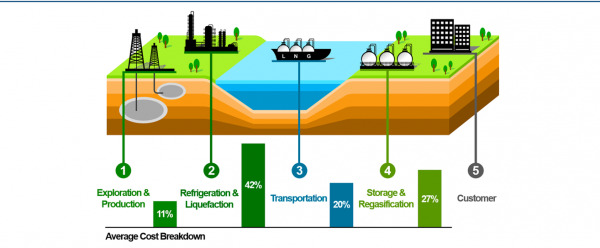
Our focus lies in the Storage and regasification stage which according to a 2017 study by  Lee, Inkyu & Park, Jinwoo & Moon Il accounts for 27% of the total cost of LNG value chain roughly a fourth hence its importance and our interest.

LNG Terminals

LNG terminals are port facilities that receive, store, convert and transport Liquified Natural gas, they are typically located ashore and are built to accommodate large LNG carrier vessels. According to the IGU 2020 report as at February 2020 ,there are currently 105 terminals currently in operation worldwide with a further 14 planned to begin operation within the next 2 years.

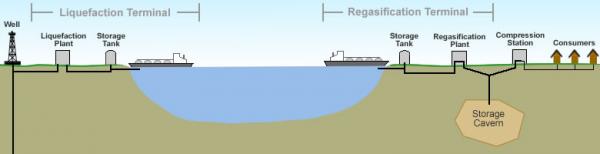
There are two types of LNG terminals based on their function namely Regasification & Liquefaction terminals respectively

Liquefaction terminals

These refer to terminals that receive pumped Liquified Natural Gas from Liquefaction plants (which are mostly situated close to the source of gas so as to reduce complexity and cost) through pipelines after which it is then stored in specialised storage tanks while awaiting transport to ships for export.

Regasification terminals

This are terminals that receive imported natural gas from ocean tankers, store it temporarily and then send it to a Regasification facility or directly to tanker trucks for transport as LNG. At the regasification plant the LNG is then converted to CNG or natural gas and distributed using pipe-line 

networks or land based transport, any additional gas is then stored using specialised underground storage tanks.

Advantages

Some of the advantages of traditional LNG terminals include.

Immense Capacity:

Perhaps the biggest factor to consider is that Terminals are built to process large volumes of Natural gas daily and they do this effectively with small terminal capacity ranging from 100,000 m3 to large terminals that can house millions of cubic feet of natural gas conveniently.

Scalability:

Another huge advantage is that traditional terminals can be easily expanded provided the required land area is available. An example is the expansion of the Nigerian LNG project at Bonny island to add a seventh LNG processing unit to increase its total production capacity from 22 million tonnes per annum (Mtpa) to 30Mtpa, and the LNG terminal expansion by Polskie LNG in Poland  to increase regasification capacity of the terminal to 7.5 billion Nm3/year and build a second jetty  for loading and unloading of LNG Vessels.

Long Service life:

Generally Terminals are built to last at least 25 years and more with proper maintenance their service life can even be extended without risking or compromising safety standards. A notable example is the Chita LNG terminal in japan which was commissioned in 1983 and is still running today.

Disadvantages

Huge cost:

LNG terminals are not cheap as they can cost upwards of 1 billion dollars in investments, they also come with huge upfront costs and are generally considered a long term investments as they take years to breakeven or show Return on Investment.

Land requirement:

LNG terminals require huge swathes of land due to the scope of activities needed to load and offload LNG from vessels, they require a jetty or harbour, a lot of surface area for the storage tanks and regasification plants as well as proper segmentation for health and safety standards.

Time of construction:

Typically LNG terminals can take anywhere from Four to six years In construction, take for example South Hook’s LNG terminal located in Milford Haven UK,  Europe’s largest LNG terminal, construction began in 2004 with over 2500 workers and was commissioned in 2009.

FRSU vessels

Floating storage and regasification units (FSRUs) are sea vessels that offer both transportation and conversion of LNG to other forms simultaneously. First developed in 2005 by transforming an already existing LNGC vessel, FRSU’s are a smaller and cheaper method of supplying Natural to small and medium markets. FRSU’s  are made up of

Storage Tanks: usually membrane or spherical Moss type tanks

Regasification unit: which converts the LNG back to natural gas by slowly heating the liquid under atmospheric pressure. Generally sea water is used except when travelling through colder regions in which case, steam from the ships boiler is used.

LNG Unloading Arms or Hoses: These are used to receive and offload the cargo to and from the FRSU which is usually transferred ship to ship. The primary advantage of hoses over unloading arms is that its cheaper and less bulky with the latter being faster in operation and easier to manoeuvre.

FRSU’s are either newly constructed or made by refurbishing already existing LNG carries and generally consists of two types as FRSU ships or offshore installations.

FRSU ships: These are vessels that are able to transport and convert LNG simultaneously and posses their own propulsion systems. They are similar to other sea faring vessels and can dock in ports and harbours

Offshore installations: these are barge like facilities that can be moored offshore their primary advantage is greater capacity than their counterparts.

According to the IGU 2020 report as there are currently 25 FRSU vessels worldwide and a further 14 vessels to be deployed in by 2021.

Advantages

Speed of deployment:

Unlike Classical terminals which take at least 5 years of construction, FRSU’s can be built and deployed under 2 years. Case in point is the FRSU Independence  in South Korea for which construction started in 2012 and operations began operations in 2014.

Flexibility:

The mobility of FRSU vessels allow flexibility in delivering Natural Gas to new markets as well as allowing for a collapsed model of operations.

Cheaper option:

They are also cheaper to build for instance the Independence construction cost was 330 million dollars a sharp contrast to the construction cost of 1 billion pounds (1.4 billion dollars). The cost is further driven down if the FRSU is constructed from a refurbished LNGC.

Disadvantages

Limited capacity:

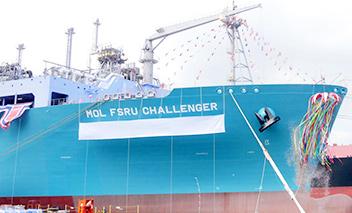
FSRU’s have a somewhat limited capacity compared to traditional terminals. For example the Korean FRSU the Challenger with a storage capacity of 263,000 cubic meters lacks in capacity when compared with traditional LNG terminals like the Arun LNG Plant, a medium sized LNG terminal in Indonesia with a storage capacity of 630,000 cubic meters. FRSU’s cant also be upgraded as easily as Traditional LNG terminals who are only limited by the available land area.
 

Short Life span:

FRSU generally last anywhere from 10 to 15 years of operations pending proper maintenance and overhauling repairs however this adds to the  overhead operational cost.

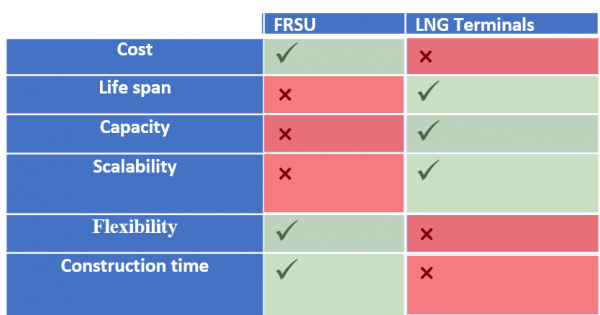
Comparing FRSU and LNG terminals

A quick recap of the benefits of the FRSU and LNG terminals
Conclusion

To say one method is better than the other would do them both injustice. Both have their place and can even be used complementarily. An example can be seen in the US where during harsh winters when demand for Natural Gas peaks , FRSU vessels where used to supplement the supply of LNG normally obtained from shale gas field.  There are several factors that influence the choice to make between adopting LNG or FRSU facilities namely life  span, capacity cost, reliability and market size. When considering large markets such as China , US and South Korea it is more economical to build Terminals when considering the market size however in smaller newer markets that aren’t LNG dependent FRSU vessels may be the viable choice.
 

KiakiaGas Limited is a leading Gas business in Lagos,Nigeria with expertise in LPG retailing, New Gas Market development, Building of Gas Plants and Gas strategy advisory.
If you need a partner with hands-on local expertise in the Nigerian Gas space or any of our bespoke solutions/services, write us at gaspreneur@kiakiagas.com or call/Whatsapp: +2348085269328
FLOATING STORAGE AND REGASIFICATION UNITS: AN EMERGING MODEL

Submitted by kiakiagas on

The last three years saw a general decline in the Floating Storage and Regasification Unit (FSRU) sector. These years have seen a change in the pervading business model, with innovative ideas being actualised. The reasons and factors behind this new trend have not been well understood by all.

In a previous  article, Floating Storage and Regasification Units (FSRUs), the trade of Liquefied Natural Gas (LNG) was examined, with a specific focus on FSRUs, which is becoming more commonly used in transporting LNG as well as regasifying LNG into natural gas. This article picks up from the previously mentioned article, with a focus on the current market trends between 2017 and 2019.


Between 2017 and 2019, the number of FSRUs in operating as terminals increased by only one unit, although there was growth in other aspects of the industry. Different countries have also begun (or continued, as the case may be) working towards having FSRUs operations as a preferred model. There has also been the introduction of the mini-FSRU, showing the industry is still going through various forms of innovations. Some nations discontinued FSRU projects due to reasons such as increased production from their gas fields.


Changes in the FSRU Sector between 2017 and 2019

Vessels in Operation

In 2017, there were 26 FSRU vessels in operation, with 23 functioning as terminals while the other three functioned as LNG tankers. By 2019, the number of units operating as terminals had increased to 24, while those operating as LNG tankers had grown to 10. This gives a total of 8 FSRUs added to the number, although the distribution was uneven. The 16 years between 2001 and 2016 produced 26 FSRUs while the three years between 2017 and 2019 produced an additional 8. The three year period from 2015 to 2017 saw a the highest growth rate of FRSUs with 15 FSRUs produced within that period. . This shows the production rate has reduced in the past couple of years.

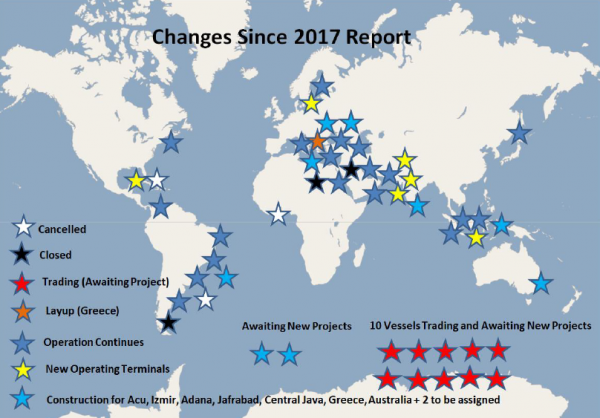
A notable occurrence in the period under consideration is the cancellation of three projects, as well as the closure of three terminals, while six new terminals were opened. The cancelled FSRU projects were in Puerto Rico, Uruguay and Ghana. Ghana had already begun construction of the FSRU-based terminal in Tema. Operations were due to commence by mid-2020 and gas was to be supplied by Gazprom.  The construction of the terminal has been suspended because Ghana discovered gas fields, increasing their domestic supply capacity. Ghana can meet short- and mid-term local gas demand; hence it deemed the construction of the FSRU-based terminal unnecessary and a moratorium has been placed on future LNG projects.

FSRUs have flexible usage, such that they could function as a terminal, just a gas carrier or a power generation platform. This flexible usage is the reason why information provided about FSRUs might not be accurate in a few months, as an FSRU used as a terminal could be leased out as a gas carrier alone. FSRU usage is based on demand. To this end, the drop in demand for LNG for power generation, and gas imports from Bolivia has led several FSRUs to depart from South America to new projects. Fifteen FSRUs are to continue operating in the same location.

There are currently 34 FSRU vessels available. The lack of corresponding terminal projects has led to an oversupply of FSRUs, with ten vessels now operating as LNG tankers (i.e. operating in back-up mode). These make up almost 30% of the FSRU fleet. This oversupply might be short-lived as new FSRU markets are emerging in Australia and Germany. 


Figure 1. Changes in FSRU Sector Between 2017 and 2019.

Source: Oxford Institute for Energy Studies. Floating LNG Update – Liquefaction and Import Terminals


Business Model

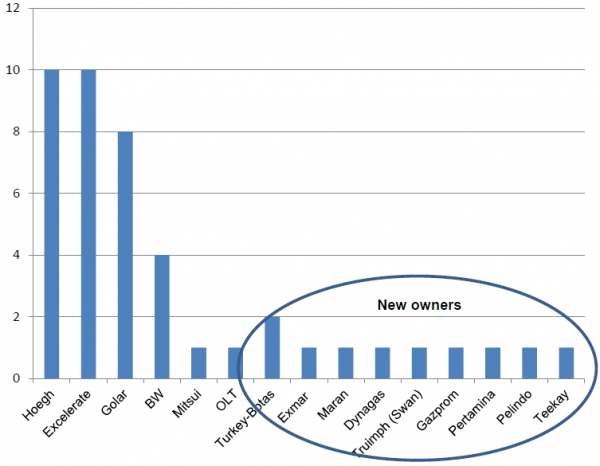
A major emerging trend noticed is that energy companies are now outrightly purchasing their FSRU, rather than leasing from the shipping companies. The traditional leasing companies, such as Golar LNG, and Hoegh, have increased their FSRU fleet size from 22 to 28, yet most of them are used as LNG tankers – yielding lower rates-  because they haven’t been many terminal projects requiring them. These companies increased their fleet size on a prospective basis, but it has not paid out so far, as vessels on tanker service earn $80,000/day, whereas those on terminal services receive $120,000/day. To this end, it is not likely that these companies will order new vessels until the currently underutilized vessels are assigned to a terminal project. The leasing companies have only two vessels assigned to terminal projects; one in Port Acu, Brazil and the other in one of two terminals (Crib Point or Port Kembla) in Australia.

One reason the new companies are now directly purchasing FSRUs, rather than leasing, could be the fact that they plan to operate these vessels for such a long period that leasing is unnecessarily expensive. An example of the switch from leasing to purchase is found in the Lithuanian Governments decision to purchase the Hoegh owned FSRU, called The Independent, in 2018. Lithuania has been leasing the vessel but decided to purchase The Independent after 2024 (it is currently under a ten-year lease agreement) after a national economic analysis was conducted. Buying the vessel will cut annual operating costs by £20 million. The shift towards ownership, at the expense of leasing, is a factor causing an oversupply of FSRUs.  In total, there are thirty-three vessels owned by the leasing companies, while nine of the units currently under construction are purchased outright for by the energy companies.

The cost of constructing (or converting a gas carrier into an) FSRU has not changed. The order value of an FSRU still ranges from $250 - $300 million.  The industry design standard is 174,000 cubic metres tanker, with 1 billion cubic feet per day (1 bcf/day) gasification capacity.


Figure 2. FSRU Vessel Owners

Source: Oxford Institute for Energy Studies. Floating LNG Update – Liquefaction and Import Terminals


The Mini FSRU

In November 2018, Indonesia received a 26,000 cubic metres capacity FSRU, called Karunla Dewata, built by the PaxOcean Group, in China. This is the world’s first mini-FSRU, and it operates in Bali, Indonesia. The mini FSRU will regasify 50 million standard cubic feet per day (SCF/d) of LNG, and it will be used to supply energy to neglected regions in Indonesia. Indonesia is relatively new to importing LNG; it has been seeking out sources of energy and the FSRU model offers several benefits to Indonesia. The vessel was designed to carry four Type C tanks, each with 6,500 cubic meters capacity. The possibility of constructing a mini-FSRU opens up more possibilities to countries seeking LNG, especially for small island communities. These small vessels can power 200 – 300 MW power stations. With time, more information would be made available on mini-FSRUs as more countries adopt this vessel model.

Outlook

The FSRU market is expected to grow steadily but at a slower rate than the high growth period of 2015 – 2017. Construction of vessels will reduce, although new FSRU markets are opening in Australia, Europe and Asia. Construction of vessels will increase once the current surplus of vessels finds assignments. Construction of FSRU vessels might become strictly based on order rather than on a prospective basis, to avoid a repeat of the current vessel surplus situation. Lastly, the mini-FSRU sector is expected to grow considerably shortly as it aids the switch from oil to gas and numerous small islands in the world need to make this switch.


KiakiaGas Limited is a leading Gas business in Lagos,Nigeria with expertise in LPG retailing, New Gas Market development, Building of Gas Plants and Gas strategy advisory.
If you need a partner with hands-on local expertise in the Nigerian Gas space or any of our bespoke solutions/services, write us at gaspreneur@kiakiagas.com or call/Whatsapp: +2348085269328 
 

FLOATING STORAGE AND REGASIFICATION UNIT (FSRU)

Submitted by kiakiagas on

The global demand for natural gas was 3.9 trillion cubic metres (tcm) in 2018, a 4.9% increase from 2017. OECD (Organization for Economic Development) countries experienced a 4.5% increase in demand for natural gas, while non-OECD countries experienced a 5.3% increase. Global gas trade surpassed the 1.2 tcm threshold in 2018. This growth can be attributed to the increase in global Liquefied Natural Gas (LNG) trade which grew by 7.3% in 2018. The prices of LNG also continued the trend of convergence, while import prices for the USA, EU, Japan and Korea all increased.


The exact composition of natural gas mostly depends on the source. Natural gas is made up of 60 – 90% methane, about 20% ethane, propane, butane and trace amounts of other gases, such as Nitrogen. When composition is almost pure methane, it is known as ‘dry’ natural gas. The presence of heavier hydrocarbons makes it ‘wet’. The heavier hydrocarbons removed in order to increase the methane presence in natural gas are referred to as Natural Gas Liquids (NGLs).


Natural Gas Transportation

Most of the world’s natural gas is delivered through pipelines, with a large network of pipelines delivering natural gas to processing facilities, as well as end consumers. Natural gas is compressed to enable pipeline transportation. The pipeline networks can be categorised into three:

  1. Gathering pipeline systems, which transport raw natural gas to the processing facilities.
  2. Intrastate/interstate pipelines, which basically transport natural gas from the processing facility to the centres of consumption.
  3. Distribution pipelines, which deliver gas to the end consumers.


In the situation natural gas cannot be delivered on land, it can be liquefied and transported by ships. Natural gas is condensed to a liquid by cooling it to -260 °F (-162°c). Liquefied Natural Gas (LNG) occupies 600 times less volume than natural gas at atmospheric temperature; this and the liquid state enables easy storage and its transport by road, rail or ship (using methane carriers). LNG is shipped from terminals and the shipment is received at terminals, where it is regasified. There are several types of LNG terminals, differing based on technology used:

  1. Onshore LNG terminal: LNG is offloaded from the methane carriers into tanks in the port, after which it is regasified then transmitted into the gas distribution system.
  2. Gravity-based offshore LNG terminal: the terminal and the regasification plant are located on an artificial island. The natural gas is then transmitted to the onshore distribution network through underwater pipes.
  3. Regasification methane carriers: the regasification facility is on the LNG carrier, and releases natural gas directly to the onshore transmission network through underwater pipes.
  4. Offshore storage and regasification terminal: a floating platform or vessel with LNG storage and regasification facilities on board. It is also known as the Floating Storage and Regasification Unit. LNG pumped from the methane carrier to this terminal is regasified, and then transferred to the onshore gas transmission network. This unit is the focus of this article.  


The Floating Storage and Regasification Unit (FSRU)

The FSRU can be classified either as a (special kind of) ship or an offshore installation. Most FSRUs are classified as ships to enable flexibility in operating them either as a FSRU or an LNG tanker. FSRUs are to be located close to the coast, inside a port or a protected area. FSRUs can be equipped in two ways:

  1. they can be installed as a separate unit aboard the LNG carrier itself, or
  2. an old gas carrier can be converted into an independent unit and placed in a particular destination as an offshore installation.

The FSRU business began in 2001, with the first FSRU built for the Gulf Gateway Project. By 2017, 26 FSRUs were in operation, with 23 operating as terminals and 3 as LNG terminals. The International Gas Union stated that FSRUs had a total regasification capacity of 84 MTPA (million tonnes per annum) based on estimates. The number of FSRUs have grown rapidly due to their relatively low capital cost, commercial flexibility, faster schedule and reusable asset feature. Land based terminals on the other hand are regarded as sunk cost.


A 2017 report stated that the cost of a new FSRU was 60% of an onshore terminal and could be delivered at half the time. New projects cost $240 - $300 million and could be constructed in 2-3 years, while FSRUs based on LNG tanker conversions cost $105 - $130 million and take 18 months to be converted (due to long delivery times of equipment, rather than the shipyard conversion itself). An example of a fast tracked project was the second Egypt FSRU which was completed in 5 months.

Comparison Between On-shore Terminals and FSRUs

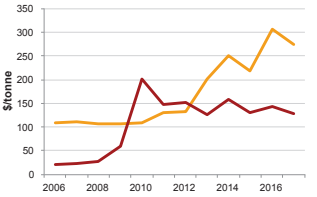
The cost of an onshore regasification has been on the rise since 2012, while that of FSRUs has remained relatively steady. The average unit cost of onshore regasification capacity that came online in 2017 was $274/tonne, while that of FSRUs was $129/tonne. It should be noted that the operating costs of FSRUs are higher than that of onshore terminals due to vessel charters associated with the project.


Figure 1. Regasification Costs Based on Project Start Dates

Source: International Gas Union. World Gas LNG Report, 2018.


Additionally, some FSRUs are used for power generation, by independent electricity companies which plan to serve developing countries. Many FSRU companies now generate power on the FSRU or on an adjacent barge, to provide a one-stop shop solution.

FSRUs consist of the following essential components:

  1. Tanks: the ‘S’ in FSRU denotes storage of the LNG, which is done in either a membrane or a spherical moss tank. The membrane tank provides better storage capacity for a ship of the same size.
  2. Regasification unit: this represents the ‘R’ in FSRU. This equipment converts the liquefied natural gas (at -162°c) back into natural gas at atmospheric temperatures.
  3. LNG Unloading Arms or Hoses: the tanker supplying LNG to the FSRU transfers the cargo either through an unloading arm fixed in the FSRU or through the use of cryogenic hoses. The arms are quicker, and easier to operate than the hoses; they also boil gas less than the hoses.      
  4. Heating medium: the regasification occurs through a heat exchange medium, where sea water is used as a heat source for warming the LNG in primary receiving terminals (except in terminals located in cold regions). Strict environmental regulations monitor this process. It is known as the open loop system. The closed loop system involves circulating pre-heated fresh water/glycol mixture.
  5. Boil-Off-Gas (BOG) Management: excess BOG is released in the FSRU (or piping ) during the loading process. This gas needs to be managed to prevent over pressurisation of the tanks. Loading or spray lines are used to reliquify the boiling gas and transfer it back to the tank.
  6. Gas Export Arms or Hoses: most inshore FSRUs export the gas via high-pressure export arms. Hoses could also be used for this job.


In 2018, the Lagos State government was in talks with Golar LNG Limited to acquire an FSRU, to provide energy security in case the gas pipeline from Delta is shut down for any reason.

It is possible that with time, the FSRUs will evolve to provide other important services and it is paramount that such innovation is used to its greatest advantage.

The number of FSRUs in operation is expected to increase as demand also increases. FSRUs might be used by some nations to act as gas terminals while onshore terminals are constructed. Other nations would use FSRUs to generate electricity. Generally, adoption of FSRUs is expected to increase over the years such that the International Gas Union (IGU) expects 50 FSRUs in operation by 2025.


The Nigerian LPG Market is the next success story of the Global LPG industry, if you need a partner with a global perspective and local expertise in the Nigerian and African space, kindly book for a free session with our team of experts to help you http://www.kiakiagas.com/book-session or write us an email at advisory@kiakiagas.com or Whatsapp: +2348085269328


Subscribe to FSRU