PROSPECT AND IMPACT OF AFRICAN CONTINENTAL FREE TRADE AREA(AfCFTA) ON THE ENERGY MARKET
PROSPECT AND IMPACT OF AFRICAN CONTINENTAL FREE TRADE AREA ON THE ENERGY MARKET
Introduction
The African Continental Free Trade Agreement (AfCFTA) entered into force on 30th May 2019 to facilitate industrialization, economic growth and prosperity in Africa. The AfCFTA aims to put together all 55 African Union Member States, representing a population of more than 1.2 billion people, with a rising middle class, and a total gross domestic product (GDP) of more than US$ 3.4 trillion. Estimates from the United Nations Economic Commission for Africa (UNECA, 2020) asserted that the AfCFTA can raise intra-African trade by 52.3 per cent by reducing import tariffs and to double the trade if non-tariff barriers are also eliminated. Originally, the main objectives of the AfCFTA are:
(i) to create a single continental market for goods and services, with free movement of business persons and investments, and thus pave the way for accelerating the establishment of the Customs Union;
(ii) to expand intra-African trade through better harmonization and coordination of trade liberalization;
(iii) to enhance competitiveness at the industry and enterprise level through exploitation of opportunities for scale production, continental market access and better reallocation of resources;
(iv) to aid the movement of capital and people in the continent and;
(v) to enhance the competitiveness of member states within Africa and in the global market.
The continent boasts of countries that are endowed with energy resources which include renewable and non-renewable energy resources to boost industrial outputs. According to Tulane University (2015), energy resource is something that can produce heat, power life, move objects, or produce electricity. Renewable energy comes from natural sources or processes that are constantly replenished. For example, sunlight or wind keep shining and blowing, even if their availability depends on time and weather while non-renewable energy sources include fossil fuels such as oil, gas, and coal which take a longer time to replenish. Countries that are endowed with non-renewable energy sources include Algeria, Angola, Egypt, Libya and Nigeria. Nigeria is Africa largest oil producer and with the second-largest proven oil reserves in Africa, produced more than 2.5 million barrels per day between 2015 and 2019. There are other countries on the other hand that are blessed with other natural resources and cannot boast of having energy in the form of fossil fuel that are necessary for industrial operation. It is against this background that African leaders deemed it fit to come together to sign an agreement that will ensure free trade of energy, goods and services without any form of restriction from the abundant countries to the needy countries. Hence the formation of African Continental Free Trade Agreement (AfCFTA).
This article will examine the effect of AfCFTA on the energy market in Africa and to create public enlightenment on the potential benefits and threats to the Africa energy market. According to the international energy agency (IEA Outlook, 2019), Africa’s population is among the fastest-growing and youngest in the world. One-in-two people added to the world population between today and 2040 are set to be African, and the continent would become the world’s most populous region by 2023, overtaking China and India. Growing urban populations mean rapid growth in energy demand for industrial production, cooling and mobility. With the growing appetite for modern and efficient energy sources, Africa also emerges as a major force in global oil and gas markets.
Potential Benefits of AfCFTA to the Energy Market in Africa
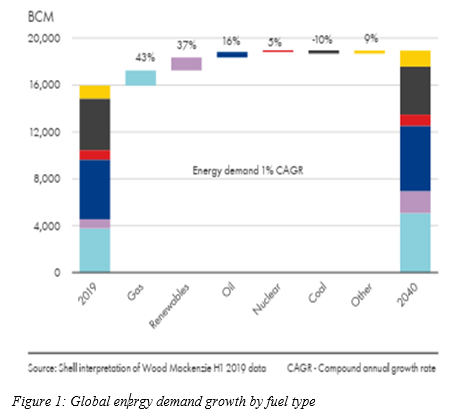
There is an increase in global demand of fuel as forecasted by the Shell LNG Outlook (2020) between renewable and non-renewable energy as renewable energy and gas are expected to replace coal in the global energy mix by 2040. Records show that demand for gas is growing by 43%, renewable energy by 37%, oil and nuclear by 16% and 5% respectively while coal declines by 10% and other nonrenewable energy are growing by 9% (see figure 1).
There are potential benefits for the African countries to also participate in the use of cleaner energy to limit the harmful emission from dirty energy. Countries like Algeria, Angola, Egypt, Libya and Nigeria who are endowed with crude oil for gas production can increase their trade volume and revenue as the world is switching to cleaner energy for commercial and domestic use. With the introduction and implementation of AfCFTA that seek to ensure free trade in the continent, these countries will be able to trade without being subject to high tariff payments. Also, against this context, AfCFTA is planned to be a continental instrument that would facilitate economic integration by establishing a single energy market, ensuring the removal of tariff barriers (TBs) and non-tariff barriers (NTBs) and allow for national trade and investment security policies.
Another potential advantage of AfCFTA is to enable cleaner energy producers to benefit from economies of scale, to access lower transmission costs and to improve the conditions for regional energy value chains. This would accelerate the transition of African economies towards greater technology and information use (Saygili, Petrs and Knebel, 2018).
AfCFTA is opening up Africa to African investors. The ability to transform Africa by making energy cheaper will be impressive. One main anticipated outcome of the deal, for example, is the increase of industrial production, which will depend on the quality, sustainability and safety of the energy sources on a scale for industrial growth. The AfCFTA will not only raise inter-regional trade in energy in Africa but will also increase the rate of trade in manufactured products, machinery, equipment and services around the African markets. The target market for AfCFTA is projected to be 1.27 billion people, predicted to grow to 1.7 billion by 2030, of which around 600 million people will be middle-class (Bramdeo, 2018). In terms of gross GDP, this would range from $2.1 trillion to $3.4 trillion or $6.7 trillion in Purchasing Power Parity terms. As a result, the demand for energy used in the industrial sector and in cooking gas will increase, thereby expanding the energy market size.
Potential Threats of AfCFTA to the Energy Market in Africa
Tariff barrier and non-tariff barrier are mostly considered to automatically facilitate free trade in the African energy market without giving more attention to the infrastructure that is not built for intra-Africa energy trade. The infrastructural facility plays a major role in the value-chain of energy. The transmission and transportation of energy within the continent require reliable infrastructure. So there are still other challenges to overcome and they need time.
Since not all goods and services would be liberalized, it goes without saying that the effect of the AfCFTA on the energy market will depend on the outcome of the ongoing negotiations. For example, the liberalization of such goods might instantly break the current monopoly of the OPEC cartel. The driving force behind this result might not be the abolition of tariffs (which will still be sequential and may not have an immediate effect on trade patterns) but the removal of non-tariff barrier.
The key challenge is to provide universal access to secure, new, affordable and renewable energy. How to do this is a core component of Africa's Agenda 2063 Strategic Vision for the Future of the Continent and of the Global Sustainable Development Goals.
Conclusion
Rising urban populations mean a rapid increase in energy demand for industrial development, heating and accessibility. With an increasing demand for new and reliable energy sources, Africa is also emerging as a major force on global oil and gas markets. Studies showed that the estimated rise in oil demand in Africa is higher than that of China and second only to that of India. This is due to the size of the car fleet that is more than double, most of which have poor fuel efficiency, while liquefied petroleum gas (LPG) is increasingly used for clean cooking. Africa's rising weight is also felt in natural gas markets as the continent becomes the third-largest source of global demand for gas over the same period. However, the forum for the removal of tariff barrier and non-tariff barrier in Africa is always a sweetener, which certainly has the potential to find alternatives for the energy market in Africa. AfCFTA's crucial mission is to address the hindrances of transmission and transportation mechanism for intra-Africa energy trade, chronic poor networking and communication.
Kindly book for a free session with our team of experts to help you http://www.kiakiagas.com/book-session or write us an email at advisory@kiakiagas.com or Whatsapp: +2348085269328