Liquefied Petroleum Gas (LPG) is produced as a by-product of natural gas processing or crude-oil refining. In 2019, the quantity of Nigeria’s marketable produced natural gas was 48 billion cubic meters, and 36 billion cubic meters of natural gas was exported. LPG is part of the family of hydrocarbons referred to as Natural Gas Liquids (NGLs) which consists of ethane, pentane and the alkanes in-between. These NGLs are further separated into individual products such as ethane, or LPG (which is a mixture of propane and butane), after which they are further processed into final products (e.g. Ethane is processed into plastic bags) or distributed as they are (e.g. LPG is distributed to end-users as a cooking fuel). The point of production is referred to as the up-stream sector.
Locally produced LPG is supplied through NLNG and stored at the terminals, mainly at Apapa, Lagos. Imported LPG is also stored in those storage terminals (also referred to as depot). Off-takers then purchase LPG from these depots and distribute them to the gas plants. The gas plants vary in size, and this size determines whether they will serve only end-users or whether they will also serve LPG retail shops. The sector which provides gas to the end-users is the Down-stream sector.
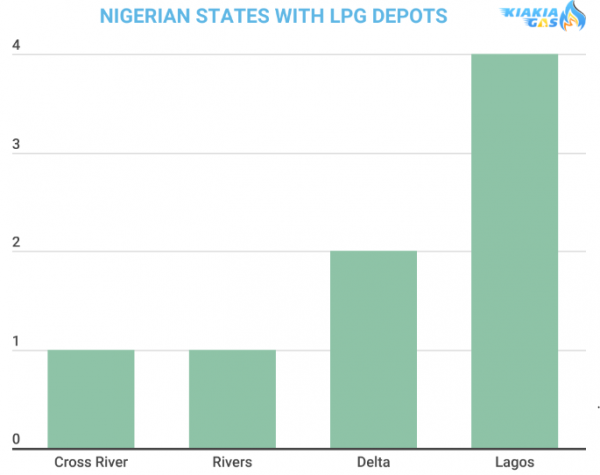
This article focuses on the operators of the storage terminals in the down-stream sector. This is a very essential service as they serve as the link the between the upstream operators and the rest of the supply chain. Storing LPG provides a form of product supply security. As in the case of Senegal, the number of terminals has a role to play in the stability of LPG supply. The LPG storage terminals receive gas from ships and then store it. The gas is then distributed via trucks to the gas plants. Nigeria currently has 8 LPG storage terminals in Lagos, Rivers, Cross-River, and Delta states.
POLICY AND REGULATORY CONCERNS
The energy market is strongly dependent on the decisions made by political actors, due to the nature of the industry. Some of these policies are either targeted at a stage in the value chain or the entire LPG value chain. The government policy which removed the monopoly in the LPG storage terminal business has resulted in an increasing number of storage terminals. The value chain effect remains; the increase in LPG demand will lead to an increase in supply infrastructure, which includes storage terminals. This flow will work especially because the terminal storage sector is operating as a free market.
Government intervention in the LPG market has involved the introduction of both policies and strategies. The Federal Government of Nigeria has a committee responsible for recommending policies and actions to increase the adoption of LPG in the country, (a target of 40% has been set) and the increase in demand will require a corresponding increase in supply facilities, such as terminals. In 2019, Federal Government of Nigeria announced the LPG expansion program which is aimed at switching auto-mobile dependence on Premium Motor Spirit (PMS) and diesel to LPG. Another example of favourable government policies includes the removal of VAT for LPG, which was to increase the affordability of the product.
STORAGE TERMINALS IN NIGERIA
-
PPMC: the Pipeline and Product Marketing Company is the downstream subsidiary business of the Nigerian National Petroleum Corporation (NNPC). The PPMC is charged with efficiently and profitably marketing refined petroleum products nation-wide. This includes ensuring regular supply of the refined products. PPMC initially had the sole right to import LPG into the country but that right was relinquished in 2000 thereby giving marketers the opportunity to import LPG. The PPMC Apapa LPG facility was enlarged from 4,000 metric tonnes (MT) capacity to 7,000 metric tonnes capacity. The PPMC terminal is located in Apapa, Lagos State.
-
NIPCO: NIPCO was the first private company to invest in providing terminals for the storage of LPG, after the monopoly of PPMC was relinquished. NIPCO originally started out with a petroleum storage tank farm at Apapa before expanding the dockyard terminal to accommodate LPG. The NIPCO terminal was commissioned in 2009. Existing NIPCO storage facilities stand at 11,000 metric tons, though NIPCO initially began with 4,800 metric tons. NIPCO has a distribution capacity of 10,000 metric tons a day. NIPCO also has a number of skid plants it commissioned to provide gas to the end-users. The NIPCO terminal is also located at Apapa, Lagos State.
-
Navgas: Navgas is a joint-venture between the Dutch Vitol Tank Terminals International BV (VTTI) and the Nigerian Industrial and Domestic Gas Limited (NIDOGAS). VTTI owns 50% of the venture. The facility commenced operations in 2010. Navgas has three (3) LPG spheres (2 butane spheres and 1 Propane sphere) with a capacity of 12,000 metric tons in total. Navgas operates with 1 jetty. They are also located in Apapa, Lagos State.
-
Matrix Energy: Matrix Energy Limited began as a supply and distributions operation and expanded into petroleum products marketing and trading company. The Matrix Group started with a storage facility for Premium Motor Spirit (PMS), then a 5,000 MT facility for LPG. The Matrix Energy LPG facility was inaugurated in 2017, and is located in Warri, Delta State.
-
Prudent Energy: Prudent Energy and services Limited, as the others, started by trading PMS, but only began operations in the LPG market in 2019. The LPG facility has a 6,000 metric ton capacity and is located at the edges of River Ethiop in Oghara, Delta State. Prudent Energy commenced their operations with LPG from Ghana, as NLNG could not meet total demand based on their allocation for the Nigerian LPG market.
-
Stockgap Fuels Limited: Stockgap trades refined petroleum products and LPG. The Stockgap LPG facility was commissioned in November, 2019 at Port-Harcourt, Rivers State. The facility has a capacity of 8,000 MT. The facility received its first cargo from NLNG. The facility is aimed at serving the populace in the South-South zone of Nigeria. Stockgap also plans to construct a second LPG terminal in Lagos.
-
Dozzy Group: the Dozzy group has petroleum storage facilities in around the country, and their LPG facility is located in Calabar, Cross-River. The facility has a capacity of 6,000 MT. Recently, the facility has not been in operation.
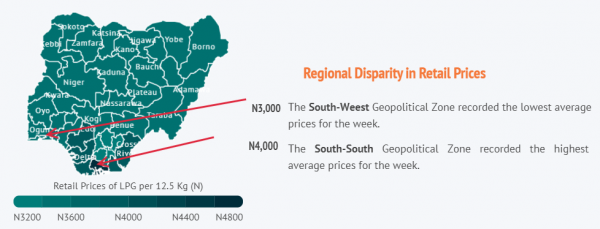
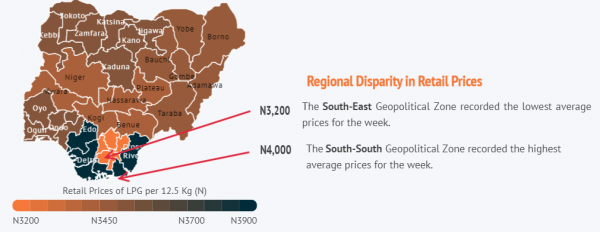
The above storage terminals are mostly located in Lagos State, with additional located in Delta, Rivers and Cross-River. The newest LPG storage terminal inaugurated is the Rainoil storage terminal, which is also located in Lagos. Most of the LPG coming into Nigeria therefore comes in through Lagos State. A recent survey indicated that the trucking costs of LPG across the country could be reduced by up to 25% if the Port Harcourt and Calabar terminals are fully functional. The effect of the status quo is seen in the prices of LPG in the South South region being the highest in Nigeria.
Source: Kiakia Gas Datapitch
Rainoil Limited: as the other companies mentioned, Rainoil Limited was originally operating in the PMS sector. Rainoil recently constructed a 50 million litre capacity multi-product depot in Ijegun, Lagos State. The Ijegun project hosts an 8,000 MT LPG storage capacity and received its first LPG cargo in July 2020. Rainoil is also investing in other aspects of the downstream LPG sector in Lagos and Benin.
Outlook
These companies invested in the LPG industry due to favourable government policies and due to the growing LPG consumption in Nigeria. Quoting the chairman of Stockgap, “the future is gas”. Currently, Nigeria has an estimated LPG storage capacity of 80,000 metric tonnes. As demand is expected to increase, investment into different aspects of the LPG downstream sector will increase and more storage facilities will be constructed, by companies with already operating terminals as well as new companies. Some of these companies are also expected to work towards full vertical integration of the downstream LPG market. Lastly, the coastal areas of the country (e.g. Cross-River) are expected to host more LPG storage terminals, as companies cater to the needs of the population there.
KiakiaGas Limited is a leading Gas business in Lagos,Nigeria with expertise in LPG retailing, New Gas Market development, Building of Gas Plants and Gas strategy advisory.
If you need a partner with hands-on local expertise in the Nigerian Gas space or any of our bespoke solutions/services, write us at gaspreneur@kiakiagas.com or call/Whatsapp: +2348085269328