Nigeria LPG Importation in 2019: signs of growth & expansion

Submitted by kiakiagas on

With Nigeria importing 76.78 million metric tonnes of Liquefied Petroleum Gas (LPG) in December 2019, there has been a significant increase with Nigeria LPG for the past decade.  The Nigerian LPG market saw a rise from 70,000 MT per annum in 2001 to over 600,000 MT per annum in 2019. The increase was made possible due to the deregulation policy and several partnerships with the private sector. 


Some of the activities of the private sector include the expansion in domestic coastal storage terminals focused on improving the capacity of the country meet local demand.  There are also ongoing plans to further increase domestic storage capacity within the country. Other private sector activities include the explosion of the number of gas plants developed across the country to serve customers.


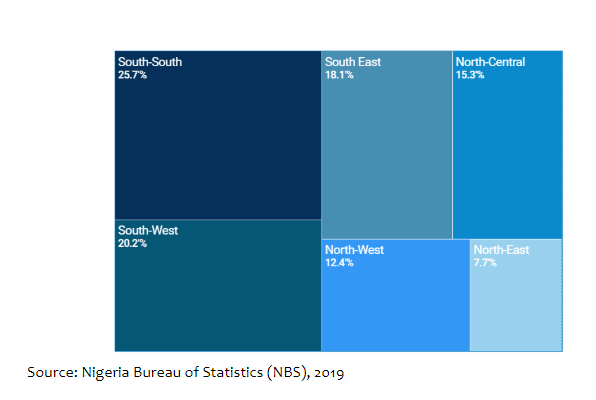
Similarly, domestic demand has also been rising in recent years.  Much of the expansion in domestic demand have come from states in the southern part of the country. The three geopolitical zones in the south (South-east, South-south and the South-west) account for over 60% of total national consumption in 2019. The South-South geopolitical zone, accounting for 25.7% of total domestic consumption is the largest LPG market in Nigeria currently by size of consumption. This is followed by the South-west which accounts for 20.5% of total national consumption as at 2019.  We reckon, among other factors, that the recent growth in demand in the south could be driven by availability of supplies through retail outlets and gas plants. Considering the population of many cities in the Northern part of the country, we envisage growth in demand in the years to come. 


We find that the share of demand in the Nigeria market does not follow population size. While most geopolitical zones in the north have greater population relative to the geopolitical zones in the south, the share of LPG consumption in the south are generally much larger, and disproportionate with the population share. The Northcentral geopolitical zone, accounting for 15.3% of total national consumption remains the largest LPG market in the North. This is followed by the North-West geopolitical zone which 12.4% of the total national consumption for 2019. The North-east geopolitical zone accounts for the lowest consumption for LPG in the country. This phenomenon may not be unrelated to the security crises as well as poverty situation in the zone. 


Figure 1: of LPG Consumption according to Geopolitical Zones in Nigerian 
According to reports of the Nigerian Liquefied Petroleum Gas Association (NLPGA), annual consumption of LPG is expected to increase from the current 600,000 MT to 5,000,000 MT by 2029. This expectation is not unconnected to the growing awareness of the important of clean energy and the growing ease with which LPG has become available in the market. The expected growth in demand must be met by an equal growth in supply. A look at the trend in the volume of imported LPG into Nigeria in 2019 merits a cursory look. 


Figure 2. Source of LPG in Nigerian LPG Market from Foreign Country
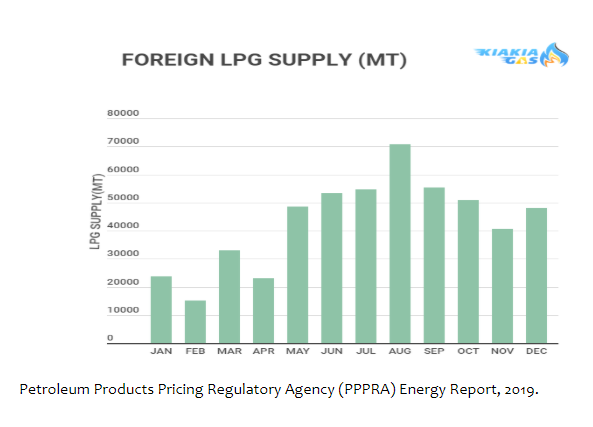
Petroleum Products Pricing Regulatory Agency (PPPRA) Energy Report, 2019.


From the graph above we could see that the volume of LPG imported into Nigeria fluctuated significantly particularly in the first quarter of 2019. August 2019 is the month with the largest import of LPG while February 2019 is the month with the lowest import volume. We also find that the period of lower imports corresponds to the winter season in parts of Europe and North America. 


Figure 2: share of imported LPG according country of origin 
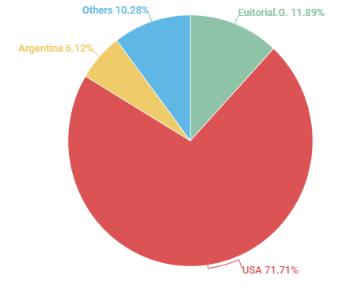
source: PPPRA 2019


Sources of Imported LPG

At least 75-80% of local LPG consumption is imported. Local production capacity, though sufficient to meet local demand, has been oriented more towards export than serving domestic LPG needs of the country. In the next two paragraphs, we explore the two leading sources of LPG imported into Nigeria: the Unites States of America (USA) and Equatorial Guinea.


United State of America:

The US supplied Nigeria about 70% of its domestic LPG imports in 2019. It is no surprise given the fact that they have been Nigeria foremost suppliers and the world’s 4th largest exporter of LPG.  The US has a bi-lateral trade relationship with Nigeria, which is a factor in trade volumes. The US stands is also the highest exporter of LPG, with an on-going infrastructure expansion to meet the growing global demand. The United States became a net exporter of LPG in 2012 due to the increase in the production of natural gas, and the shale oil and gas boom. Exports to Nigeria makes up a negligible 0.4% of the total amount of LPG exported from the USA. This falls back to the market size of the Nigerian LPG market. Nigeria is 10 times more populated than Netherlands, yet the Netherlands imported 1.7 million tonnes of LPG from the United States in 2019, which is more than two times the total consumption of LPG in Nigeria for the same year. 


Equatorial Guinea: Equatorial Guinea has a successful history of implementing large gas utilization projects. Equatorial Guinea has had a strong presence as a global exporter of LPG and oil in general with top priority in building a sustainable development of the entire value chain — linking upstream production with industry, electricity production and economic diversification. Their drive to monetize gas has been key to the development of industry, especially in the last two decades, with nearly 50% of the country’s annual hydrocarbons production comprised of dry gas, condensate and natural gas liquids. With the development of the Punta-Europa which was established as far back as 2001, which propelled them to the world map, has made it possible for them to process natural gas into a variety of products , including liquified petroleum gas, compressed natural gas, methanol and liquified natural gas. LNG from Europe is exported, making Guinea one of few countries in Africa which includes Nigeria to successfully export LNG.


Other Countries: Argentina, India and other countries account for the rest of the imported LPG into Nigeria. The share of imports from these countries are generally not very consistent and change significantly over the period of a year. 


Conclusion 

Nigeria has over the years been mostly importing the bulk of its domestic LPG consumption. Growth of domestic consumption have been led mainly by states in the south of the country. The rise in local demand has not be proportionate with population share across the country.


If the trends continue coupled with low domestic storage capacity, per capita consumption may remain very low when compared with other African countries with lower population figures. One possible solution should be for the government to revamp refineries for improved LPG production. Other will be to provide incentives for LPG retail, distribution and domestic storage capacity development within the country. On the demand side, it might be important to develop programmes that encourage households to transit to the use of LPG by providing them with incentives to like access to cylinders and cooking stove at subsidized rates or with some moratorium for payment. Such a programme portents great opportunity to grow domestic consumption of LPG as more than 20 million households still use dirty fuel aa their primary cooking energy.


Thank you.


The Nigerian LPG Market is the next success story of the Global LPG industry, if you need a partner with a global perspective and local expertise in the Nigerian and African space, kindly book for a free session with our team of experts to help you http://www.kiakiagas.com/book-session

Or write us an email at advisory@kiakiagas.com or Whatsapp: +4915210247560, +2348085269328


BETWEEN THE NIGERIAN AND SENEGALESE LPG MARKET

Submitted by kiakiagas on

Nigeria and Senegal are located in the West African region; one with numerous mineral resources but not as much economic development. Both Sub-Saharan countries are experiencing growth in their youth populations, yielding a growing labour force and increasing urbanization.


In 2018, Nigeria had an estimated population of 200 million people, with a Gross Domestic Product (GDP) of 397 billion dollars, and a GDP per capita of $2,000 (World Bank Development Indicators, 2018). Senegal, on the other hand, had a population of 16 million people, with a GDP of 24 billion dollars and GDP per capita of $1,500 (World Bank Development Indicators, 2018). Senegal does not have crude oil reserves but produces a small quantity of natural gas.


Both countries have a number of demographic and socio-economic similarities:

  • Most of the land in both countries is used for agriculture; 78% for Nigeria and 46% for Senegal.
  • growth rates.
  • Both countries are made up of citizens of diverse ethnicities.
  • Both countries have a burgeoning youth population.


As urbanization increases in both countries, so do deforestation and carbon emissions, due to felling of trees for use as cooking fuel. This results in environmental and health hazards, and does not favour economic growth. Currently, 60% of the urban population in Senegal use LPG – without subsidies; but wood and charcoal represented 60% of Senegal’s total energy consumption when Senegal’s Butanization policy was implemented. About 60% of Nigerian households also use wood and charcoal.

The use of LPG as the prevalent cooking fuel will provide a cleaner environment without affecting the health of the users, as well as provide employment for individuals in the value chain. Both countries acted on these facts by implementing policies to increase the consumption of Liquefied Petroleum Gas (LPG) in their respective countries, although Senegal implemented their policies decades before Nigeria implemented hers. Senegal’s success and the processes involved can be used examined, and adapted to obtain similar results in Nigeria. In the rest of the article we examine the Nigerian and Senegalese LPG markets along the lines of market size, supply chain structure and enabling policy.


  1. Market Size

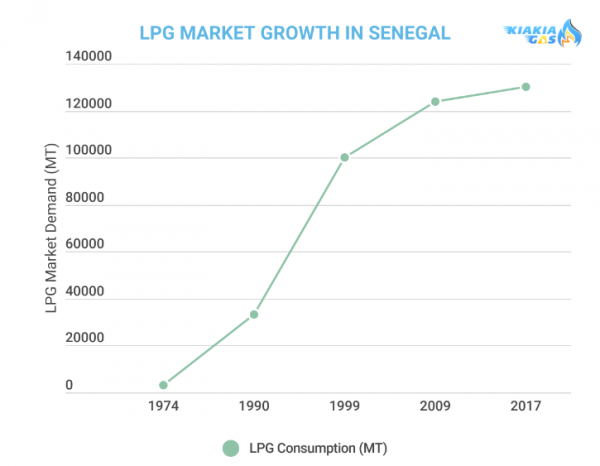
In 2018, the larger portion of the Senegalese population (particularly the urban regions) used LPG as their fuel for cooking, with 1.5 million LPG stoves in use. The Butanization program, championed by the Senegalese government in 1974, caused the market to experience growth through the years, resulting to an annual consumption of 170,000 MT in 2017. This is 56 times larger than the annual consumption at the time the Butanization programme began. The growth rate, however, began to slow down after the removal of LPG subsidy in 2009.

Senegal has been able to achieve this level of LPG usage despite their relatively limited natural gas reserves. A large portion of the LPG used in the country is imported. About 98% of the country’s LPG consumption is from the domestic and commercial sectors.


Figure 1. Growth in Senegalese LPG Consumption

     Source: (Chantelot, 2001) (Kojima, 2011) (Tyler, 2018)


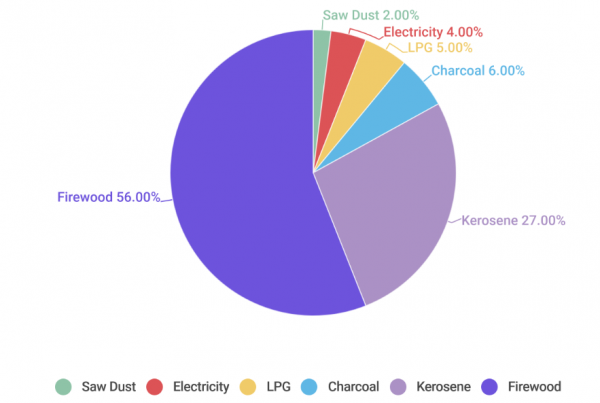
The Nigerian LPG market has also been experiencing growth. The Nigerian LPG demand grew from less than 60,000 MT per annum in 2008 to 800,000 MT per annum in 2019.  The National Gas Policy report of 2017 revealed that only 5% of the households in Nigeria use LPG - that is just 2 million households using LPG. Majority of the country (50-60%) currently depend on wood as a fuel source. There is a great potential for more growth in the Nigerian LPG market, and there are corresponding investments in all points of the Nigerian LPG value chain.

Figure 2. Nigerian Household Energy Mix

Source: National Gas Policy, 2017.


2. Supply Chain Structure

In 1963, the Societe Africaine de Raffinage (SAR) was inaugurated and given the exclusive permission to import LPG into Senegal after which it passed it on to the various private distributors. Supply of LPG in Senegal faced challenges because the country had just one (functional) container berth, limiting its storage capacity, thereby affecting total supply to the county. The country also has multinational companies (such as TOTAL and VITOGAZ), as well as independent local companies (such as Touba Gaz) distributing LPG to the wholesale outlets. The wholesale outlets supply to the retailers, who then supply to the end-users. The wholesalers specialize in the sale of LPG through gas plant facilities, while the retailers are those with shops and stores; they sell other items alongside LPG. The bulk of the LPG consumed in Senegal is imported, due to low local production capacity.

The Nigerian LPG market is fully deregulated; hence the private sector plays a major role in importing the product. Nigerian LPG production surpasses local demand by a ratio of 5 to 1, based on 2017 data, yet 60% of the LPG used in Nigeria is imported. Nigeria Liquefied Natural Gas Limited (NLNG) supplies locally produced LPG to the Nigerian market, while there are other private companies which import LPG into the country (such as Navgas and Matrix Energy). LPG, whether local or imported, is stored in any of the country’s six depots (based on the company which bought it)  from where it is sold to the gas plants. These gas plants sell to (some end-users and) the retailers who then sell to the end-users. Retailers in Nigeria are specialized in selling LPG alone, unlike their counterparts in Senegal. 60% of the LPG used in Nigeria is imported, due to low local supply capacity on the part of the main local LPG producer, NLNG (production and infrastructure).


3. Policy

In Senegal, the Comité National des Hydrocarbures (CNH) acts as a market price regulator for all petroleum products. It acts as an advisor for the Senegalese Ministry of Energy, reviewing the prices of petroleum every 4 weeks. The price of LPG in Senegal was subsidized by the government as part of the Butanization program but the program ended in 2009.


Senegalese Butanization Programme

The Butanization programme began in 1974, as a strategy by the Senegalese government to reduce deforestation, partly caused by the use of wood as a domestic fuel source (over 60% of the population at that time used wood or charcoal). The LPG demand at the commencement of the programme was just 3,000 MT.  The aim of the Butanization programme was to increase LPG consumption and decrease the reliance on biomass, particularly amongst the low-income sections of the population.

In 1974, the standard LPG package available was the 12kg cylinder with a regulator, hose and stove. The government introduced the 2.75 cylinder, with its appropriate equipments and later on, introduced an 80% subsidy on 2.75kg refills. The 6kg cylinder (with a 60% subsidy for refills) was introduced later. This created three different price structures for the 2.75kg cylinder, 6kg cylinder and the 12kg cylinder (unsubsidized). These price structures were set by Presidential decree based on the joint recommendation of the Ministry of Energy and the Ministry of Trade. The subsidies were funded from revenues obtained from taxes on other products. LPG related equipments also enjoyed tax exemptions.

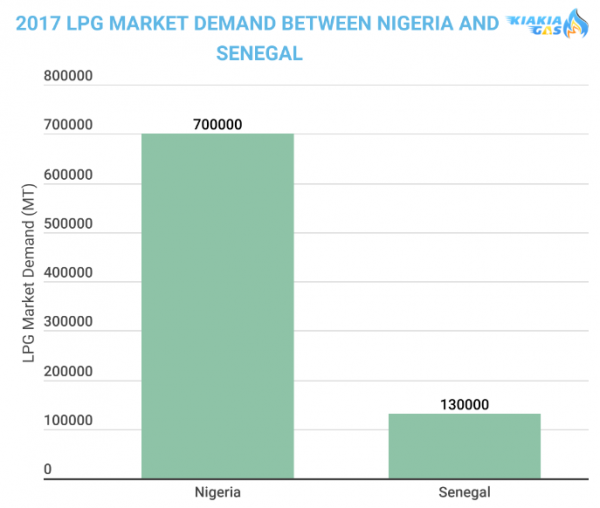
The subsidy increased the consumption of LPG and in turn led to a decrease in deforestation by 15%, but was unsustainable; hence the International Monetary Fund (IMF) recommended the removal of the subsidy. The subsidy was removed in 1985, but returned two years later due to social unrest. The subsidy was finally removed in 2009, leading to a 12% increase in charcoal use. In 2017, Senegal consumed 130,000 MT per annum, showing LPG had gained a considerable market share due to the programme which had long been discontinued.


Nigeria had to incorporate necessary policies to ensure the growth of the Nigerian LPG market. These include the complete deregulation of the LPG market, removal of kerosene subsidy, as well as distribution of 3kg cylinders to low-income households. There’s no monopoly on the importation of LPG into Nigeria, as there are different companies bringing the product into the country. Due to the deregulation of the industry, prices move based on the prices at the international market. 

The deregulation policy allowed for greater private sector investment in the LPG sector e.g. the NavGas depot which came into operation in 2010. Steps are also being taken to improve local supply to local demand (8% of local supply is channelled to meeting local demand), by increasing local production. There are also investments in the production of domestic LPG equipments, such as cylinders to replace mostly expired cylinders used in Nigeria (90% of LPG cylinders used in Nigeria are expired).

Figure 3. Comparison Between Nigerian and Senegalese LPG Consumption

Source: WLPGA, Accelerating the LPG Transition 2018.


The Nigerian and Senegalese LPG markets share some similarities, such as the dependence on imported LPG, as well as LPG competing with wood and charcoal. Senegal has been able to successfully convert the greater percentage of its households into LPG users, showing the possibility of same success rate in Nigeria. Comparing populations shows that Nigeria today has a greater market potential than Senegal did in 1974. Due to the early start, Senegal has been able to convert most of its population into LPG users in 4 decades (90% of households in Dakar use LPG), and Nigeria could do same in a shorter time if the right steps are taken.

A nationwide sibsidy system for Nigeria might not be effective, but it could make LPG cheaper to low-income households. That objective can be achieved by ensuring local (production and) supply grows to meet the growing local demand.


KiakiaGas Limited is a leading Gas business in Lagos,Nigeria with expertise in LPG retailing, New Gas Market development, Building of Gas Plants and Gas strategy advisory
If you need a partner with hands-on local expertise in the Nigerian Gas space or any of our bespoke solutions/services, write us at gaspreneur@kiakiagas.com or call/Whatsapp: +2348085269328


Subscribe to lpg market