Effects of COVID-19 Pandemic on AfCFTA and Oil & Gas in Africa.

Submitted by kiakiagas on

Introduction


The African Continental Free Trade Area (AfCFTA) agreement is made up of 54 African countries merging into a single market of 1.3 billion people. With the benefit of developing sustainable markets, this resource could create an economic bloc with a combined GDP of $3.4 trillion. Intra-African trade is projected to rise by 33 percent once in operation and Africa's overall trade deficit is expected to be halved. Furthermore, by 2030, the AfCFTA could generate $6.7 trillion in combined consumer and business spending. Trading is expected to begin on 1 January 2021 under the AfCFTA. Not only is AfCFTA a free trade agreement, it is a tool for the economic transition of Africa. It will promote the movement of individuals and labor, competition, investment and intellectual property through its different protocols. According to the World Bank, it is estimated that the AfCFTA could boost regional income by 7% or $450 billion, speed up wage growth for women, and lift 30 million people out of extreme poverty by 2035. This could be achieved through existing human and natural resources endowment in Africa, most especially the oil and gas resources that are channeled majorly to the western and eastern part of the world.


Africa has considerable oil and gas resources that can help accelerate growth on the continent if used strategically. The African continent is home to five of the world's top 30 oil producing countries. In 2019, it accounted for over 7.9 million barrels per day, which is about 9.6 percent of world production. This production level has fallen considerably from the peaks of 2005 to 2010, when African production amounted to almost 10 million barrels a day. While new resources are increasingly being found, they are not distributed equally; indeed, 38 African countries are currently net importers of oil. Since last year, Africa's share of global oil production has marginally increased by 0.3% to 8.7%, standing at 8.1 million bbl/d. Nigeria, Angola, Algeria, and Egypt continue to be significant contributors. In 2017, Libya doubled production, promoting it with an 11 percent share to the fourth largest oil producer in Africa, bringing Egypt into fifth place. At the end of 2017, Africa was estimated to have 487.8 tcf of proven gas reserves, unchanged at 7.1 percent of proven global reserves. Two major gas discoveries by Kosmos Energy added an additional 1.5 billion BOE of gas to their portfolio in the Senegal-Mauritania basin. According to Kosmos and joint venture partner BP, the Yakaar discovery, combined with the Teranga discovery in 2015, provides the basis for another LNG center in the basin. Most of the big oil production declines between 2010 and 2015 are attributed to lower global oil prices. Production between 2015 and 2019 has stabilized. However, the pandemic of the Corona virus and a production dispute between Saudi Arabia and Russia drastically lowered oil prices in early 2020. As a consequence, as of June, potential oil output trends in Africa and around the world were highly uncertain.
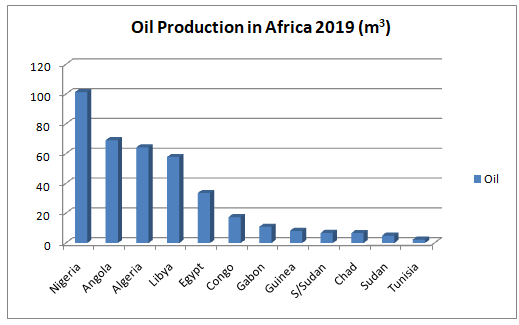
 

Source: Statista 2021


The Corona Virus Disease 2019 (COVID-19) is a communicable respiratory disease caused by a new strain of COVID-19 that causes illness in humans. Scientists are still learning about the disease, and believe that in animals, the virus originated. The disease spreads by contaminated air droplets, which are projected during sneezing or coughing, from individual to individual. It may also be transmitted when humans come into contact with hands or surfaces containing the virus, and when infected hands touch their eyes, nose, or mouth. In China, COVID-19 was first published, but it has now spread worldwide and Africa is no exception.


The novel COVID-19 strains the health systems, education, aviation, culture, commerce, and general livelihoods of Africa as well as the public and private sectors of the continent in the midst of lockdowns, stifling income streams. The International Monetary Fund has revised the continent's GDP growth projection from 5.1% before the pandemic to -1.6%. Similarly, from 2.4% in 2019 to between -2.1% and -5.1% in 2020, the World Bank has projected a similar decrease. Compared to other countries, on the one hand, mortality from the pandemic has been very low, but the economic impact would be immense. These reports signal the region's first recession in the past 25 years. In times of an unprecedented health crisis, policymakers need a stimulus package as well as trade instruments, such as the AfCFTA deal, to boost economic recovery. The benefits of liberalized trade would be granted to African countries. It can serve as an alternative stimulus package for job creation, foreign exchange, industrial development and economic growth to improve intra-African trade.


Many factories in Africa have changed production because of global shortages and have revamped to produce basic protective equipment. In Ghana, one of the largest liquor manufacturing firms shifted production to manufacturing hand sanitizer, while in Kenya, in a country that barely manufactured any before the pandemic, a factory retooled to manufacture 30,000 surgical masks a day. Similarly, the Hawassa Industrial Park started the manufacture of face masks in Ethiopia to ease the rising demand due to the pandemic. In addition, their governments also encouraged factories in Morocco, Rwanda, South Africa and several others on the continent to manufacture protective equipment to prevent the virus. In South Africa where U-Mask has redirected its production from protective masks for mining and agriculture to that for medical respiratory masks, and Nigeria where the National Agency for Science and Engineering Infrastructure produced made in Nigeria ventilators.
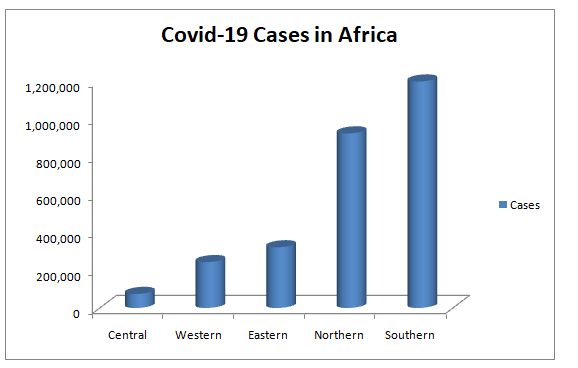
 

Source: AfricaCDC 2021


COVID-19 IMPACTS on Oil and Gas in Africa


In 2019, the African economy was set to expand at approximately 3.4 percent and is projected to rise to 3.9 percent in 2020, but COVID-19 had a very negative effect due to a major oil price crash. Given the global disruption of the supply chains in the major global trading countries, trade in the oil and gas sector has been especially affected. The deep reorganization of global supply chains has impacted African oil and gas operators. The Covid-19 crisis has revealed that global value chains centralized in a single area do not represent an ideal investment for governments in terms of protection, as well as risk for oil and gas companies.


Africa is also more vulnerable to the impact of Covid-19 because as more countries in Africa lock down their economies and apply movement controls, oil and gas demand was disrupted. Consumers of gas at home quickly switch to the alternative energy for cooking. They replace the liquefied petroleum gas (LPG) for firewood which is not far-fetched from their environment. This resulted into low demand and reduction in oil and gas revenue in Africa.


Conclusion


Africa's economic activities, especially the oil producing nations that export their oil and gas to developed countries, were disrupted by the Covid-19 crisis. But it also gives African countries an opportunity to fix them. For instance, by concentrating on goods of greatest need during the health crisis, they might accelerate intra-regional trade. In order to advance industrialization, develop infrastructure and enhance good governance, countries should also start building regional value chains. The acceleration of the AfCFTA is expected to be very significant in the long term for the reconfiguration of oil and gas supply chains, the establishment of regional value chains and the boosting of the production of critical value-added goods. Given this ability, the AfCFTA is being marketed as Africa's stimulus package to counter the devastating effect on African economies of the COVID-19 pandemic.
AfCFTA Policy Implications and Effects of Gas Pipeline Infrastructure On Economic Development of Sub-saharan African Countries

Submitted by kiakiagas on

Introduction

The Africa vision of the accelerated economic and industrial development was established by the Heads of State and Governments of the African Union in 2015 and is incorporated in the national planning framework of over 30 countries. In this case, faster economic expansion is accompanied by the full achievement of access to electricity and clean cooking, in line with Sustainable Development Goal. It is against this background that leaders in Africa reached an agreement to actualize the Sustainable Development Goal by fostering economic expansion through a stable energy supply in African countries. On 30th May 2019, the Agreement established the African Continental Free Trade Area (AfCFTA). The general objectives of AfCFTA include the creation of a single and liberalized market, free movement of capital goods and people, eliminate tariff and non-tariff barriers and many more. Trading under the AfCFTA Agreement was expected to begin on 1 July 2020, but due to the global pandemic of COVID-19, this date has been postponed till 1 January 2021.

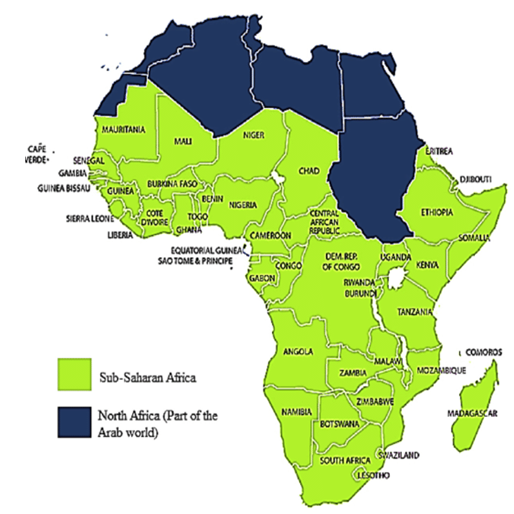
The stated objectives of the AfCFTA will ensure equal resources distribution, both human and natural resources in the continent, especially in the sub-Saharan region where demand is high compared to North Africa. This is so because of the number of countries that made up the region. These countries include Angola, Benin, Botswana, Burkina Faso, Burundi, Cameroon, Central African Republic, Chad, Congo, Cote d'Ivoire, Eritrea, Ethiopia, Gabon, Gambia, Ghana, Guinea, Guinea-Bissau, Kenya, Lesotho, Liberia, Madagascar, Malawi, Mali, Mauritania, Mauritius, Mozambique, Namibia, Niger, Nigeria, Rwanda, Senegal, Sierra Leone, Somalia, South Africa, United Republic of Tanzania, Togo, Uganda, Zaire, Zambia, Zimbabwe. As evidenced in figure 1 below, the most populous country and the biggest economy in Africa, Nigeria, is located in sub-Saharan Africa. Sub-Saharan Africa will therefore experience an increased demand for electricity and clean energy to meet their basic needs.

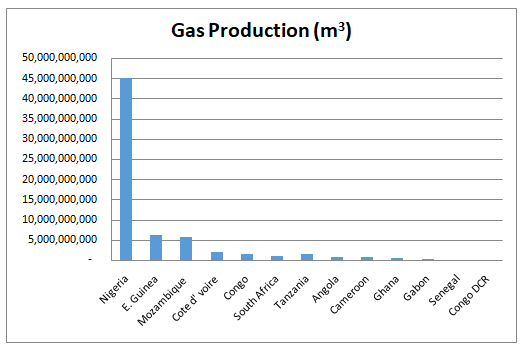
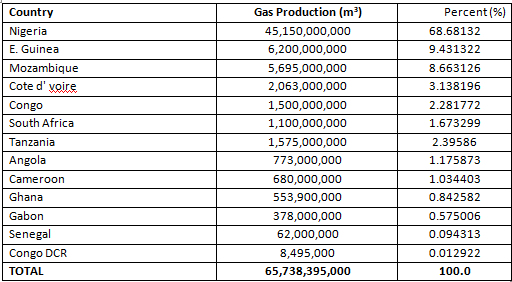
The region is endowed with dirty and clean energy; however, as the world is switching to cleaner energy, Natural gas to be specific, there is the need to transport clean energy from the endowed countries to the needy countries within sub-Saharan Africa. This will also help in actualizing the objective of the AfCFTA to foster economic expansion through a stable energy supply in not only in the region but to Africa as a whole. Natural Gas deposits have been discovered in 14 countries Sub-Saharan Africa, with Nigeria’s gas reserves accounting for 68 per cent of proven reserves. Several undeveloped fields in other parts of Africa account for 32 per cent of total gas resources. The gas producing countries are listed in table 1 below in accordance to the World Factbook (2020):

Table 1: Gas Producing Sub-Saharan Africa Countries World Factbook (2020)

Figure 2: Gas Producing Sub-Saharan Africa Countries

Source: World Factbook (2020)

In order to ensure equitable distribution of the gas resources, it is important to develop infrastructure for the importation of natural gas to support local demand in other sub-Saharan countries with no gas reserves. This will require sufficient investment in upstream natural gas infrastructure. With increased demand from household, commercial and industrial users, the lack of infrastructure is becoming a constraint. Extensive pipeline installations from collection, refining and storage facilities to end-user facilities are pivotal to steady market performance.


Some regional economic communities have done a great deal to liberalize trade with their neighbours, by permitting the free movement of people and building cross-border infrastructural links. An example of such regional initiatives/projects is the West African Gas Pipeline (WAGP). Nigeria, Benin, Togo and Ghana built the first regional pipeline in 1982 known as the WAGP. It is a natural gas pipeline to supply gas from Nigeria's Escravos region of Niger Delta area to Benin, Togo and Ghana.

The Trans- Saharan Gas pipeline initiative to run from Nigeria through Niger Republic to Algeria and Europe was the second attempt to build a regional gas pipeline infrastructure. However, this project was marred by Niger Delta Militant activities and high cost that was involved. While Africa's network of gas transportation infrastructure and services is still disjointed, the gas sector is showing signs of greater integration, particularly in the less endowed sub-Saharan Africa countries. The AfCFTA policy and framework should serve as a tool to establish a gas pipeline in the sub-Saharan region because of the potential benefits it holds.


Potential Benefit of Pipeline Infrastructure to Economic Development in Sub Saharan Africa

A well-structured gas pipeline network will ensure fast and reliable transportation of gas from the endowed countries to the needy countries. This will give quick access to clean energy for lighting, and power industrial machines for mass production of goods and services. Investors and entrepreneurs will grab the opportunity to increase their capacity to produce more quality goods and services, thereby leading to economic development in sub-Saharan Africa. Below are some of the potential benefits of pipeline infrastructure:


Increasing Economic Efficiency

There is a greater awareness of the role of pipeline infrastructure in socio-economic development. If countries endowed with natural gas in sub-Saharan Africa exploit it at daily maximum capacity and supply to other countries that are not endowed with natural gas, this will improve the Africa per capita income. The transition from traditional means of transport to modern gas pipeline infrastructure carries the greatest hope for millions of people in the sub-Saharan Africa countries for quick access at a lower cost.


Macro productivity

A sub-Saharan Africa-led approach to gas pipeline infrastructure development will help leverage private investment through expanded market size, allowing investors to reduce road transportation risks. In the longer-term, the interconnections of gas pipeline infrastructure will lower supply costs by replacing the traditional means of transporting gas in the region. This has a very important implication for the debt burden of many Africa economies that have been trading electricity across borders.


Increased Demand

Demand for natural gas in the region is expected to grow as the population increases every year. According to the Africa Energy Outlook (2019), Africa’s population is among the fastest-growing and youngest in the world. One-in-two people added to the world population between today and 2040 are set to be African, and the continent becomes the world’s most populous region by 2023, overtaking China and India. A regional approach to meeting the demand makes economic sense if this approach to gas pipeline construction to convey gas throughout the region is adopted.


Cost Efficiency

Sub-Saharan gas pipeline infrastructure cooperation and integration offer one of the most promising and cost-efficient options for the countries. Building gas pipeline infrastructure will keep the environment safety as well as social and economic benefits from more efficient use of resources.


Security of the Gas

Security of the gas supplied will be ensured with gas pipeline facilities in the region and gas flaring will be minimal and this will also enhance environmental quality.

It is the negative environmental “externalities” associated with energy supply and use but not energy itself that can lead to economic failures.

Conclusion

The vision and commitment of African leaders to the objectives and principles of economic cooperation led them to create the African Continental Free Trade Area (AfCFTA) as an instrument for fostering African economic development. This commitment aims to ensure barrier-free trade in relation to gas and pipeline facilities which envisages the need to establish gas pipeline infrastructure for quick-access and easy transportation of gas from the well-endowed countries to the needy countries in the sub-Saharan African countries. This increased demand will create a better job market as suppliers will need to build up their workforce. Increased income then results in additional demand of consumer goods and services, thus persuading a complete round of economic stimulus. This establishment can be achieved if the principles embodied in the AfCFTA are fully implemented. African leaders are therefore implored to fully implement the AfCFTA policies for speedy economic emancipation and growth in the Sub-Saharan region.


Subscribe to Effects