AfCFTA and its potential for oil and gas producing countries in Africa: The case of Nigeria, Angola, Algeria, Libya and Egypt
Introduction
Africa is well endowed with minerals, including fossil fuels. The AfCFTA is the first step in implementing the 2063 AU Agenda: a vision for an Africa that is united, stable and peaceful. The African Continental Free Trade Agreement (AfCFTA) would encourage major extra investment in the oil and power industries of Africa. The AfCFTA envisages a single continent-wide market for products and services with free movement of individuals and investments. If successfully executed, an immense single market will be created by the AfCFTA, which today has 1.3 billion consumers. The AfCFTA seeks to increase intra-African trade by phasing out tariff and non-tariff barriers, improving competition and developing all the sectors of the economy including oil and gas sector in Africa.
The Oil and gas sector includes upstream, midstream and downstream. Upstream operations include searching and drilling of natural gas reserves or crude oil fields underwater and underground. Midstream operations includes oil and gas transportation, storage, and refining while downstream operations involve refining during the upstream process and the marketing and commercial distribution of natural gas, diesel oil, ethanol, petrol, lubricants, petroleum, jet fuel, asphalt, heating oil, liquefied petroleum gas (LPG) and a host of other types of petrochemicals.
Overview of the Top 5 Oil & Gas Producing Countries in Africa
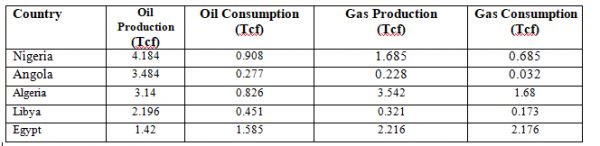
Nigeria is Africa's largest producer of oil. It holds the largest reserves of natural gas on the continent and was the world's fifth largest exporter of liquefied natural gas (LNG) in 2018. According to the Department of Petroleum Resources, Nigeria had an estimated of 203.16 trillion cubic feet (Tcf) of proven natural gas reserves by the end of 2020. Nigeria has the largest reserves of natural gas in Africa. Nigeria produced 1,685 Tcf of dry natural gas in 2019, according to the latest EIA estimates (Table 1). Nigeria exports natural gas mainly as LNG. Infrastructure and demand constraints are challenges for exports mainly by pipeline to neighboring countries.
Angola: Following Nigeria, Angola is the second-largest oil producer in Africa. The crude oil and natural gas sector accounted for about 30 percent of the country's gross domestic product (GDP), 95 percent of total exports, and about 52 percent of total fiscal revenue in 2017, according to the African Development Bank (AfDB). In 2017, around 1.55 million b/d of crude oil was exported by Angola, most of which went to the Asia-Pacific region. Angola holds an estimated 10.9 trillion cubic feet (Tcf) of proved natural gas reserves, produces 0.228 Tcf of dry natural gas in 2019 and consuming (Table 1)
Algeria: In the beginning of 2018, Algeria kept an estimated 12.2 billion barrels (b) of proved crude oil reserves. In 2017, Algeria produced an approximate average of 1.0 million b/d of crude oil and the output of other liquids averaged more than 1.6 million b/d. Algeria exported about 580,000 b/d of crude oil in 2017.France and the United Kingdom were the largest export destination countries by volume, importing 92,000 b/d and 82,000 b/d, respectively. According to the EIA, Algeria’s gross natural gas production was 3.542 Tcf in 2018. Algeria exported approximately 2.0 Tcf of natural gas in 2016, of which approximately 1.4 Tcf was transported via pipelines.
Egypt is Africa's largest non-OPEC oil producer and the third-largest producer of dry natural gas on the continent. As a result of rising domestic demand and decreasing output levels, Egypt became a net natural gas importer in 2015. Egypt has approximately 65.2 trillion cubic feet (Tcf) of proven natural gas reserves at the end of 2016, an improvement from the 2010 estimate of roughly 59 Tcf and the fourth largest in Africa.
Libya holds the largest proven reserves of crude oil in Africa, the fifth largest proven reserves of natural gas on the continent, and has been a significant contributor to the global supply of medium, sweet (low sulfur) crude oil in recent years, which Libya primarily exports to European markets. Typically, most of Libya’s crude oil is sold to European countries. In 2014, about 84% of Libya’s crude exports were sent to Europe. Libya’s dry natural gas production 0.321 trillion cubic feet (Tcf) in 2018while consuming a total volume of 0.173 Tcf.
Table 1: 2018 Oil & Gas Production and Consumption in Trillion Cubic feet (Tcf)
Source: EIA 2021
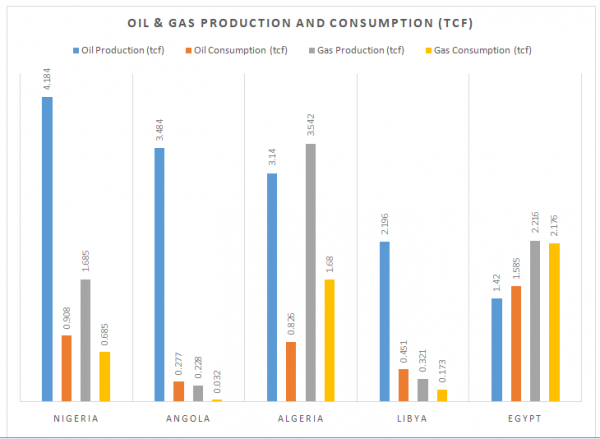
Figure 1: 2018 Oil & Gas Production and Consumption in Trillion Cubic feet (Tcf)
Source: EIA 2021
POTENTIAL OF AFCFTA FOR THE MAJOR OIL AND GAS PRODUCING COUNTRIES
Creating the largest single market of about 1.2 billion energy consumers: The establishment of the AfCFTA which has kicked off on 1st of January 2021 has the potential to open a booming market for the oil &gas producing countries in Africa. This market is estimated to involve more than 1.2 billion population in Africa who cannot do without consuming energy either for cooking, lighting and fuelling industries for the production of manufacturing products. Africa is also known as a continent that has major force work in the Agricultural sector. Providing energy to aid the large commercialization of farming, this will expand the oil and gas market to create more revenue for the oil producing countries. Households who are familiar with the use of dirty energy for cooking will be exposed and enlightened through the market established by the AfCFTA. This will increase the market demand of the LPG in the market.
Increase real wages for both skilled and unskilled workers in oil and gas sectors: Real wage is the quantity of goods and services that the amount paid to the workers in the oil and gas sector can buy at a given period of time. Expansion in the oil and gas market through AfCFTA will increase the revenue accrued to the sector. This will enable the sector to also motivate oil and gas workers by increasing the nominal wages and expand the real wages of the skilled and unskilled workers in the sector. Increase in capacity to buy more goods and services by the oil workers means that more money will be available for health care, feeding and shelter, payment of children school fees at ease and increased in saving. This will increase the standard of living of the workers and also increase the workers’ efficiency. Their morale to increase marginal product in the oil and gas sector as a result of additional wages they received will be boosted.
Increasing innovation and invention to boost oil and gas production, distribution and efficiency: The established market through the AfCFTA will result in the oil and gas producing countries in Africa to compete and divide the market share among themselves. The country that has advanced technology to deliver oil and gas with the fastest means of payment may gain larger market share. This will force other players in other countries to engage their skilled workers in research and development by devising faster way to transport large quantity of oil and gas to consumers in the market.
Conclusion
AfCFTA and its potential for oil and gas producing countries in Africa has been analysed. It is observed that with the production capacity of the countries producing oil and gas in Africa, they still export their oil and gas to the western and eastern part of the world. Such exporting volume could now be sold at AfCFTA market without spending more on transportation cost and at custom free duty. These countries will generate more revenue and more gas will be saved from flaring. However, with ever-increasing new oil and gas discoveries in Ghana, Tanzania, Mozambique and Uganda, for example and prospective fields in several countries like Sierra Leone, Mali, Kenya), the oil and gas sector still provides a unique opportunity that can be exploited.