Influence of AfCFTA on Enhancing Oil and Gas Market in Africa

Submitted by kiakiagas on

The AfCFTA agreement, which commenced on January 1, 2021 was signed by 54 African Union member countries and envisages the establishment of a massive free-trade zone with the potential to generate an estimated US$3.2 trillion worth of inter-country trade across Africa. The African Union (AU) says that the AfCFTA will create the world’s largest free trade area estimating that its implementation will lead to around a 60% boost in intra-African trade by 2022. The vision and commitment of African leaders to the objectives and principles of economic cooperation, led them to create the African Continental Free Trade Area (AfCFTA) as an instrument for fostering African economic development. This commitment aims to ensure barrier-free trade in relation to gas and pipeline facilities which envisages the need to establish gas pipeline infrastructure for quick-access and easy transportation of gas from the well-endowed countries to the needy countries in the sub Saharan African countries. This increased demand will create a better job market as suppliers will need to build up their work force. Increased income then results in additional demand for consumer goods and services, thus persuading a complete round of economic stimulus.


The Oil and gas sector includes upstream, midstream and downstream. Upstream operations include searching and drilling of natural gas reserves or crude oil fields underwater and underground. Midstream operations includes oil and gas transportation, storage, and refining while downstream operations involve refining during the upstream process and the marketing and commercial distribution of natural gas, diesel oil, ethanol, petrol, lubricants, petroleum, jet fuel, asphalt, heating oil, liquefied petroleum gas (LPG) and a host of other types of petrochemicals.


Recently, there have been a series of major new gas discoveries across Africa in recent years. This includes a “significant” find off South Africa’s southern coastline earlier this year, along with new discoveries in Ghana, Nigeria and Senegal, to name but a few. In Eastern Africa, Mozambique and Tanzania are well advanced towards utilizing their natural gas reserves. In North Africa, it would appear that the latest gas discoveries in Egypt and the Eastern Mediterranean will soon be utilized to feed domestic growth. These developments could fit well with Africa’s push for industrial growth and its need for reliable electricity supply (constraining the expansion of more polluting fossil fuels). Much will depend on the price at which gas becomes available, the development of distribution networks, the financing available for infrastructure and the strength of policy efforts to displace polluting fuels.


Status of Oil and Gas in Africa before AfCFTA implementation


Just as Africa’s oil industry was recovering from the aftermath of the 2014 oil price crash, another global crisis cast a thick shadow over oil markets worldwide in 2019. The Covid-19 outbreak stalled business activity and shut down air travel globally, causing the International Energy Agency (IEA) to announce that demand would fall to its lowest rate in almost 10 years. The crisis has changed how oil producing countries across the African continent view their oil industries. Africa becomes a major player in natural gas as a producer, consumer and exporter. Gas demand in Africa doubles to 2040 in the Stated Policies Scenario. Countries like Algeria, Angola, Egypt, Libya and Nigeria who are endowed with crude oil for gas production can increase their trade volume and revenue as the world is switching to cleaner energy for commercial and domestic use. With the introduction and implementation of AfCFTA that seeks to ensure free trade in the continent, these countries will be able to trade without being subject to high tariff payments. AfCFTA is opening up Africa to African investors. The ability to transform Africa by making energy cheaper will be impressive. One main anticipated outcome of the deal, for example, is increase in industrial production, which will depend on the quality, sustainability and safety of energy sources at scale for industrial growth.


Major Oil & Gas Consuming Countries in Africa


Prior to the inauguration and implementation of AfCFTA, African countries purchase their oil and gas from Singapore, Denmark, Switzerland, Maldives, South Africa and Nigeria while the largest consumer of crude petroleum in Africa include Egypt, Algeria and Nigeria (fig 1). On the other hand, the growth in Africa population is an advantage to boost Africa oil & gas sales. According to the Statista (2020) Nigeria has a population of 206. 1 Million, followed by Ethiopia (114.9 Million) Egypt (102.3 Million) Congo Republic (89.5 Million), Tanzania (59.7 Million) and South Africa (59.3 Million).


Figure 1: Natural Gas consumption of 10 African Countries (Bcf)
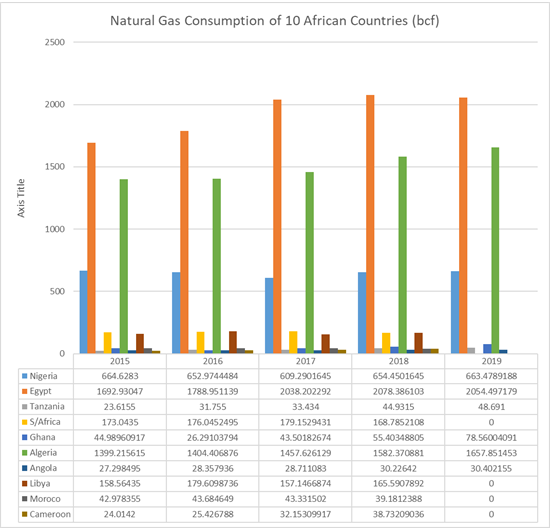
Source: EIA 2021


Benefit of the AfCFTA Oil and Gas Market


  • It would create the largest single market of about 1.2bn consumers of Oil and gas

This market is estimated to involve more than 1.2 billion consumer in Africa that consume oil and gas in one way or the other, domestic cooking, factory & home lighting and industrial fuel for the production of consumer products. AfCFTA oil and gas market will boost the sector workforce due to increase in human capital efficiency as a result of the incentives that will be created in the sector.


  • Increased Demand

Demand for natural gas in the region is expected to grow as population increases every year. According to the Africa Energy Outlook (2019), Africa’s population is among the fastest growing and youngest in the world. One-in-two people added to the world population between today and 2040 are set to be African, and the continent becomes the world’s most populous region by 2023, overtaking China and India. A regional approach to meeting the demand makes economic sense, if this approach to sales of oil and gas is adopted.


  • Could boost Africa’s economy to $29trn by 2050

Investors will be motivated to meet up with the increase in demand thereby causing inflow of capital from the Eastern and Western worlds to the African Continent. Large machines will be shipped in to produce large quantity of consumer product. The machineries need energy inform of oil and gas to run production. This will signal to the oil producing countries to increase their production capacity. More workers will be employed and new technology will be adopted to produce large volume of oil and gas at cheaper rate. As more goods and services are produced, the African GDP will be boosted and aim will be accomplished by 2050.


Conclusion

Influence of AfCFTA on enhancing Oil and Gas market in Africa has been examined and it is observed that Africa has the opportunity to create the largest market in the world for oil and gas than seen in many other parts of the world, or economic zones. Africa’s unique position as a major natural resource country makes this even more realizable. The AfCFTA is a tremendous opportunity to not only oil and gas market growth but also to create regional public goods, especially infrastructure, that will enable a prosperous and sustainable future for Africa oil and gas.


AfCFTA and its potential for oil and gas producing countries in Africa: The case of Nigeria, Angola, Algeria, Libya and Egypt

Submitted by kiakiagas on

Introduction


Africa is well endowed with minerals, including fossil fuels. The AfCFTA is the first step in implementing the 2063 AU Agenda: a vision for an Africa that is united, stable and peaceful. The African Continental Free Trade Agreement (AfCFTA) would encourage major extra investment in the oil and power industries of Africa. The AfCFTA envisages a single continent-wide market for products and services with free movement of individuals and investments. If successfully executed, an immense single market will be created by the AfCFTA, which today has 1.3 billion consumers. The AfCFTA seeks to increase intra-African trade by phasing out tariff and non-tariff barriers, improving competition and developing all the sectors of the economy including oil and gas sector in Africa.

The Oil and gas sector includes upstream, midstream and downstream. Upstream operations include searching and drilling of natural gas reserves or crude oil fields underwater and underground. Midstream operations includes oil and gas transportation, storage, and refining while downstream operations involve refining during the upstream process and the marketing and commercial distribution of natural gas, diesel oil, ethanol, petrol, lubricants, petroleum, jet fuel, asphalt, heating oil, liquefied petroleum gas (LPG) and a host of other types of petrochemicals.


Overview of the Top 5 Oil & Gas Producing Countries in Africa


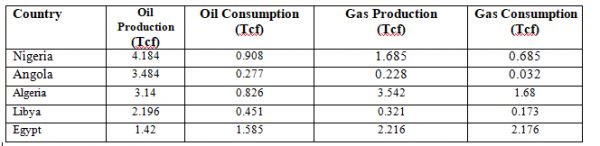
Nigeria is Africa's largest producer of oil. It holds the largest reserves of natural gas on the continent and was the world's fifth largest exporter of liquefied natural gas (LNG) in 2018. According to the Department of Petroleum Resources, Nigeria had an estimated of 203.16 trillion cubic feet (Tcf) of proven natural gas reserves by the end of 2020. Nigeria has the largest reserves of natural gas in Africa. Nigeria produced 1,685 Tcf of dry natural gas in 2019, according to the latest EIA estimates (Table 1). Nigeria exports natural gas mainly as LNG. Infrastructure and demand constraints are challenges for exports mainly by pipeline to neighboring countries.


Angola: Following Nigeria, Angola is the second-largest oil producer in Africa. The crude oil and natural gas sector accounted for about 30 percent of the country's gross domestic product (GDP), 95 percent of total exports, and about 52 percent of total fiscal revenue in 2017, according to the African Development Bank (AfDB). In 2017, around 1.55 million b/d of crude oil was exported by Angola, most of which went to the Asia-Pacific region. Angola holds an estimated 10.9 trillion cubic feet (Tcf) of proved natural gas reserves, produces 0.228 Tcf of dry natural gas in 2019 and consuming (Table 1)


Algeria: In the beginning of 2018, Algeria kept an estimated 12.2 billion barrels (b) of proved crude oil reserves. In 2017, Algeria produced an approximate average of 1.0 million b/d of crude oil and the output of other liquids averaged more than 1.6 million b/d. Algeria exported about 580,000 b/d of crude oil in 2017.France and the United Kingdom were the largest export destination countries by volume, importing 92,000 b/d and 82,000 b/d, respectively. According to the EIA, Algeria’s gross natural gas production was 3.542 Tcf in 2018. Algeria exported approximately 2.0 Tcf of natural gas in 2016, of which approximately 1.4 Tcf was transported via pipelines.


Egypt is Africa's largest non-OPEC oil producer and the third-largest producer of dry natural gas on the continent. As a result of rising domestic demand and decreasing output levels, Egypt became a net natural gas importer in 2015. Egypt has approximately 65.2 trillion cubic feet (Tcf) of proven natural gas reserves at the end of 2016, an improvement from the 2010 estimate of roughly 59 Tcf and the fourth largest in Africa.


Libya holds the largest proven reserves of crude oil in Africa, the fifth largest proven reserves of natural gas on the continent, and has been a significant contributor to the global supply of medium, sweet (low sulfur) crude oil in recent years, which Libya primarily exports to European markets. Typically, most of Libya’s crude oil is sold to European countries. In 2014, about 84% of Libya’s crude exports were sent to Europe. Libya’s dry natural gas production 0.321 trillion cubic feet (Tcf) in 2018while consuming a total volume of 0.173 Tcf.


Table 1: 2018 Oil & Gas Production and Consumption in Trillion Cubic feet (Tcf)

Source: EIA 2021


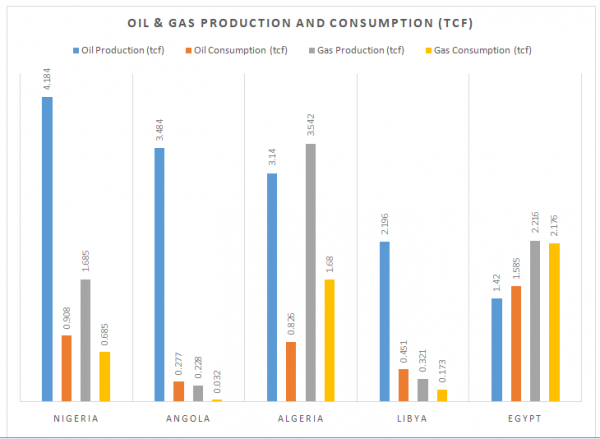
Figure 1: 2018 Oil & Gas Production and Consumption in Trillion Cubic feet (Tcf)

Source: EIA 2021


POTENTIAL OF AFCFTA FOR THE MAJOR OIL AND GAS PRODUCING COUNTRIES


Creating the largest single market of about 1.2 billion energy consumers: The establishment of the AfCFTA which has kicked off on 1st of January 2021 has the potential to open a booming market for the oil &gas producing countries in Africa. This market is estimated to involve more than 1.2 billion population in Africa who cannot do without consuming energy either for cooking, lighting and fuelling industries for the production of manufacturing products. Africa is also known as a continent that has major force work in the Agricultural sector. Providing energy to aid the large commercialization of farming, this will expand the oil and gas market to create more revenue for the oil producing countries. Households who are familiar with the use of dirty energy for cooking will be exposed and enlightened through the market established by the AfCFTA. This will increase the market demand of the LPG in the market.


Increase real wages for both skilled and unskilled workers in oil and gas sectors: Real wage is the quantity of goods and services that the amount paid to the workers in the oil and gas sector can buy at a given period of time. Expansion in the oil and gas market through AfCFTA will increase the revenue accrued to the sector. This will enable the sector to also motivate oil and gas workers by increasing the nominal wages and expand the real wages of the skilled and unskilled workers in the sector. Increase in capacity to buy more goods and services by the oil workers means that more money will be available for health care, feeding and shelter, payment of children school fees at ease and increased in saving. This will increase the standard of living of the workers and also increase the workers’ efficiency. Their morale to increase marginal product in the oil and gas sector as a result of additional wages they received will be boosted.


Increasing innovation and invention to boost oil and gas production, distribution and efficiency: The established market through the AfCFTA will result in the oil and gas producing countries in Africa to compete and divide the market share among themselves. The country that has advanced technology to deliver oil and gas with the fastest means of payment may gain larger market share. This will force other players in other countries to engage their skilled workers in research and development by devising faster way to transport large quantity of oil and gas to consumers in the market.


Conclusion

AfCFTA and its potential for oil and gas producing countries in Africa has been analysed. It is observed that with the production capacity of the countries producing oil and gas in Africa, they still export their oil and gas to the western and eastern part of the world. Such exporting volume could now be sold at AfCFTA market without spending more on transportation cost and at custom free duty. These countries will generate more revenue and more gas will be saved from flaring. However, with ever-increasing new oil and gas discoveries in Ghana, Tanzania, Mozambique and Uganda, for example and prospective fields in several countries like Sierra Leone, Mali, Kenya), the oil and gas sector still provides a unique opportunity that can be exploited.


Impact of AfCFTA on Human Capital Development in the Nigeria oil and gas sector

Submitted by kiakiagas on

INTRODUCTION

The African Continental Free Trade Area (AfCFTA) is being established by the fifty-four Member States of the African Union (AU) to create a single continent-wide market for goods and services and to facilitate the movement of capital and persons. The African Continental Free Trade Area Agreement (AfCFTA) will create the world's largest free trade area, based on the number of participating countries. The deal ties 1.3 billion individuals with a cumulative Gross Domestic Product (GDP) estimated at US$3.4 trillion across 55 countries. It has the potential to lift 30 million people out of extreme poverty, but attaining its full potential would depend on major economic changes and trade facilitation initiatives put in place. The AfCFTA has the potential to boost intra-Africa trade, promote industrialization, trade, job creation, and unleash regional value chains to facilitate Africa’s meaningful integration into the global economy. The AfCFTA will also improve the prospects of Africa as an attractive investment destination. It will help advance the empowerment of human resources, by improving access to trade opportunities.


On July 7, 2019, Nigeria signed the AfCFTA agreement in Niamey during the 12th extraordinary session of the Assembly of the African Union. Having consulted various trade groups, the country observed that there is more to gain from increasing access to its goods and services to a wider African market. Nigeria is the world's sixth biggest producer of crude oil. The bulk of crude oil exploration and production is concentrated in the Niger Delta. Over 95% of the country's foreign revenue and about 80% of its government revenue is generated by its oil and gas industry. According to the International Labour Organisation over 65,000 direct jobs are generated in Nigeria by the oil and gas industry alone, and more than 250,000 in non-direct employment. The 61 Operating companies in the Nigerian Oil & Gas Industry Content Joint Qualification System (NOGICJQS) have a combined staff strength of 11,057 comprising 10,393 (94%) Nigerians and 664 (6%) expatriates. Out of the 61 operating companies the top 4 companies in terms of staff strength account for 86% and have a total workforce as shown below:


  1. Mobil Producing Nigeria Unlimited: 3,253; comprising Nigerians 3,029, expatriates 224
  2. Chevron: 2,961; comprising Nigerians 2,736, Expatriate 225
  3. Shell Petroleum Development Company: 2,178; comprising Nigerians 2,100 and Expatriate 78
  4. Nigeria Agip: 1,088; comprising Nigerians 1,043 Expatriate 45

In line with the report provided by the Nigerian Content Development & Monitoring Board (NCDMB), between 2015 and 2019, the human capital training in the oil and gas sector involved 1,612 youths covering the following skill areas:

• 1,000 youths in Oil Spill Management and Environmental Remediation Training (OSMERT)

• 15 youths in Machinist

• 10 youths in underwater welding

• 80 in Geosciences

• 22 in pipe mill operations

• 90 in artisanal trades

• 145 in poultry agribusiness

• 250 in Teachers’ curriculum Development

NCDMB funds and promotes trainings and human capital development across the oil and gas value chain in Nigeria. Oil and gas sector has three main key areas that include upstream, midstream and downstream

  • Upstream operations include searching for natural gas reserves or crude oil fields underwater and underground and the drilling of exploration wells and drilling into proven oil and gas recovery wells.
  • Midstream operations includes oil and gas transportation, storage, and refining. When resources have been extracted, they have to be transported to a refinery, which, compared to oil and gas reserves, is often in a completely different geographical area. From tanker ships to pipelines and trucking fleets, transport can involve everything.
  • Downstream operations involve refining during the upstream process of the raw materials produced. This means crude oil refining and natural gas purification. Marketing and commercial distribution to customers and end users of these goods in a range of forms, including, though not limited to, natural gas, diesel oil, ethanol, petrol, lubricants, petroleum, jet fuel, asphalt, heating oil, liquefied petroleum gas (LPG) and a host of other types of petrochemicals.


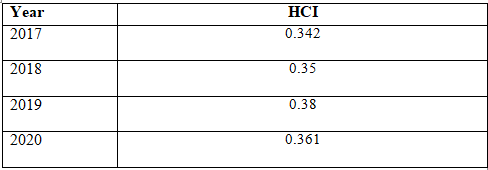
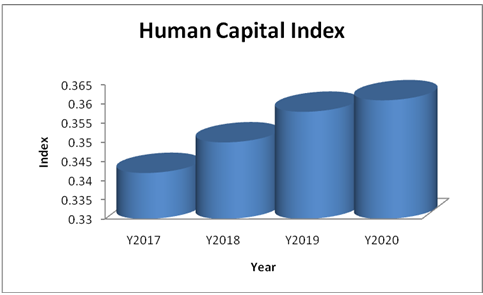
According to the Organisation for Economic Co-operation and Development, human capital is the knowledge, skills, competencies and other attributes embodied in individuals or groups of individuals acquired during their life and used to produce goods, services or ideas in market circumstances. Nigeria as a nation is immensely blessed with human, oil and gas resources. The availability of these resources from one end to the other is sufficient in such a way that economic growth might have been accomplished in the late 20th century, given dynamic leadership. Investment in human capital plays an important role in increasing competition in oil and gas industry, improving quality of life and in generating Nigeria economic growth. According to Anyanwu et al., (2015), Nigeria envisaged to be among twenty most developed countries in the world by year 2020. It is a glaring fact that the country has failed to realize its full growth potential, amid all the abundant human and natural resources. This is not unconnected to the inability to invest in human resources and develop human capital to attain a full employment and sustainable economic growth at the end of the year. The establishment of AfCFTA therefore presents an opportunity in Africa to engage and develop their human resources in the area where they have competitive advantage over others. Table 1 below shows the index for Nigeria human capital development which helps to point to the reasons for the current situation.


Nigeria Human Capital Index

Source: World Bank 2020


Effect of AfCFTA on Human Capital Development in Oil and Gas Sector

Eradicate Structural Unemployment: AfCFTA has the potential to bridge the gap of structural unemployment in the oil and gas industry. A major issue in modern economies is that rapid deindustrialization has left many manual workers, struggling to thrive in a very different labour market. But AfCFTA will create a viable market that will be competitive for the oil and gas products. This will result to investing in education, research and human capital development to create a competitive means of producing petroleum products and use a cost effective means to transport it to the AfCFTA market.


Reduce Human capital flight: the era of globalisation has enabled skilled workers to move from African countries to the developed countries. This has had adverse effects on the African economy that lose its best human capital to the western and eastern countries. The establishment of AfCFTA will reduce export of skilled labour not only in the oil and gas sector but also in other sectors of the economy. Africa possessed high-skilled, innovative workforce that are ever ready to add value to raw materials in the exploiting, mining and manufacturing process.


Employment creation in the industry: The African Continental Free Trade Area (AfCFTA) presents a major opportunity to engage human resources that are idle most especially in the Nigeria oil and gas sector. The establishment of AfCFTA will bring millions of Nigerians out of extreme poverty and raise the incomes of existing labour in the sector. With the implementation of AfCFTA, trade in petroleum products and facilitation measures that cut red tape and simplify customs procedures would boost human morale to engage the market. This will make it possible for Nigerians to be interacting with over 1.2 billion population who are keen and ready to purchase petroleum products in the AfCFTA market.


Conclusion

Impact of AfCFTA on human capital development in the Nigeria oil and gas sector has been examined. The establishment of the African Continental Free Trade Area (AfCFTA) is expected to reduce structural unemployment, human capital flight and create more employment opportunity in the Nigeria oil and gas. Human capital is an important factor used in converting specific natural resources to oil and gas for human use and benefit. The viable market opportunity of 1.3 billion population and competition among the oil and gas producing countries in Africa will trigger investment in human resources to achieve the best output at lower cost from the industry. It is high time for the actors in the Nigeria oil and gas sector to increase investment in human resources in order to stay highly competitive in the market when AfCFTA is launched in January 2021.


Natural Gas Production Capacity and Its Effect on Nigerian Economy

Submitted by kiakiagas on

Introduction


Natural gas is an energy source often used in the manufacture of plastics and other commercially essential organic chemicals as a heating fuel, cooking gas, fuel for automobiles, fuel for electricity generation, and petrochemical feedstock. Hydrocarbon gases (methane, ethane, propane, butane, pentane and heavier hydrocarbons), non-hydrocarbon gases (carbon dioxide, hydrogen sulfide, nitrogen and water vapour) and occasionally mercury are the components of natural gas. During the discovery of crude oil, natural gas is not directly searched for, and it is only as an ‘accident’ that it is discovered either alone or with crude oil. Natural gas is found either as associated gas, or non-associated gas or as condensate, deep underground formations. During the production of crude oil, the associated gas is generated through separators. Before it can be used, natural gas needs processing. In the British thermal unit (Btu), the amount of energy obtained when a unit volume of natural gas is burned is determined and called the Heating Value.


Capacity to Produce Natural Gas


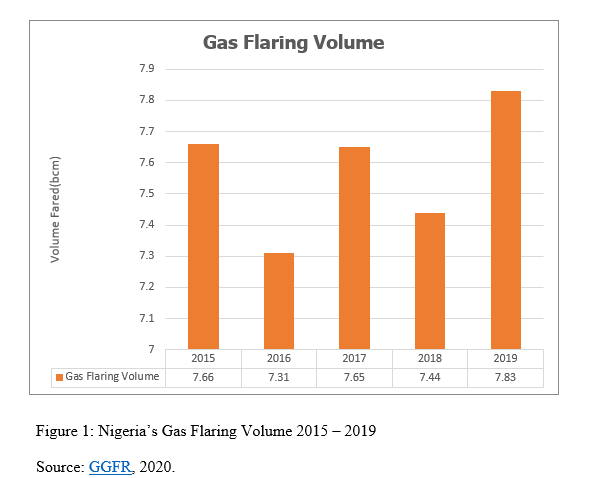
Nigeria is a growing economy that depends on both crude oil and natural gas from the domestic and international market. According to the EIA (2020), Nigeria had an estimated 200.4 trillion cubic feet (Tcf) of proven natural gas reserves, the largest natural gas reserves in Africa. EIA (2020) also asserted that the current annual gas production of Nigeria is about 1.6 Tcf of dry natural gas in 2019. Comprehensive and integrated gas utilization Master plan/programmes have been embarked upon, in which natural gas developments is being given priority. A large amount of the total natural gas output of Nigeria is either re-injected or flared. Some of Nigeria's oil fields lack infrastructure, known as associated gas, to collect the natural gas produced with oil. According to the most recent data by the World Bank’s Global Gas Flaring Reduction Partnership (GGFR, 2020), Nigeria flared about 37.89 billion cubic feet (Bcf) of natural gas from 2015 – 2019, making Nigeria the seventh-largest natural gas flaring country in terms of annual natural gas flaring volume (see fig 1).


This volume of flared gas is not unconnected to the inadequate storage system and processing facilities, low domestic and industrial utilization of gas; lack of natural gas transmission, distribution systems, and irregular pricing policy. As a result of this less attention is given to the natural gas flared without imagining its contribution to the Nigeria economy. This could have resulted in creating new industries; capturing economic value and generating as much revenue from gas as from oil. The expected result could also increase export earnings from LNG, coupled with adequate domestic power supply, will strongly support and broaden economic expansion and urbanization. Consequently, this will increase the income-generating capacity of Nigerians and lift the general wellbeing of Nigerians. It will further reinforce the Government's efforts towards integrating the Host communities into the mainstream of national development and growth. ​


Potentials of Natural Gas to Boost Economy


The country aims to improve the Nigerian economy by leveraging the full potential of the natural gas it provides. These include Liquefied Natural Gas (NLNG), the Gas-To - Liquid Project, the Liquid Natural Gas Project, the Gas Injection Project and the Gas Pipeline Project. All these ventures have the potential to contribute to the economy of the country. For many industries to drive heavy-duty machinery, heat for domestic use, and feedstock for petrochemical industries, natural gas is an important energy source for power plants to produce electricity. When combusted, it is cleaner, releasing little or no harmful environmental by-products and adding the least amount of Green House Gas (GHG).

Natural gas in Nigeria has the potential to boost the economy and the well-being of its people. It can be used to generate electricity to power companies and lighten houses. Two main turbines that produce electricity through a rotating shaft are gas turbines and steam turbines. Both turbines utilize natural gas as the primary fuel for energy input to the turbine. While gas turbine utilizes the heat energy generated from the combustion of the gas to drive the turbine shaft, the steam turbine utilizes the heat energy to generate super dry steam, which drives the turbine shaft. Thus, generate electricity to put machines and electrical appliances into use.

Improved employment of Nigerians by the natural gas industry is guaranteed in a country where the rate of unemployment is 12.84%. The industry also has the capacity to create employment in ancillary firms which are dependent on the industry. With the natural gas endowment, Nigerians can be employed in exchange for wages and salaries. The employees will increase their demand for consumer goods and this will trigger the manufacturing sector to produce and supply more of the product to the market. In trying to maximize profit, the industries in the manufacturing sector will be cost-effective by opting for low and efficient inputs. Factors inputs will then be allocated efficiently in order to maximize output and revenue. Natural gas as low cost, effective and clean energy will lead to the use of energy to power machines in the industries. This will generate more revenue for oil and gas industry and policies will be put in place to devise means of saving and storing the natural gas. A resource allowed to flare would now be sold to generate more revenue. The oil & gas and manufacturing sectors will be motivated to save excess of the revenue that is generated. This will in turn aid the financial institution to spread and render financial aid for short term to other sectors of the economy.


Demand is already high, companies and industries will generate revenue within a short period of time. This will enable them to pay both the principal and interest attached to the financial institutions. The purchasing manager of the manufacturing sector which has hit sixth-month slow growth will pick and this signals a rise in the gross domestic product with a moderately monitored rate of inflation. Natural gas is an apt product when it comes to low volume of emission from transportation. Compressed natural gas is presently used as fuel for vehicles. The Compressed Natural Gas (CNG) is not only cheap and clean to use compared to petrol but Nigeria economic growth can as well be boosted via sales of the natural gas to the gas processing company.


The contribution of Nigeria's oil and gas sector to the Gross Domestic Product (GDP) is nearly nine per cent in the second quarter of 2020. Between April and June 2020, the oil and gas industry contributed up to 8.93 per cent of the total real GDP, a slight decrease compared to the same period of 2019. As stated the sector accounts for about 9% of Nigeria’s GDP and 91 per cent of Nigeria's export value was generated by mineral fuels, oils, and distillation products' sector in 2018, accounting for approximately 58 billion U.S. dollars. The oil and gas sector in Nigeria has the potential to contribute much more to Nigeria’s GDP than it currently does. The Federal Government of Nigeria must not be complacent because the sector generated nearly all of the Federal Government’s revenue through royalty payments and taxes. With increased in-country petroleum refining capacity, the petroleum sector will be more connected to the wider economy, resulting in a greater contribution to the country’s GDP.


Conclusion


The capacity of Nigeria to produce natural gas, her gas reserve and the volume that the country flared for four years, the consequence of which is the pollution of the air, water, and soil, had been discussed. The article also showed various plans to boost the production of natural gas and how the product can enhance the Nigerian economy. Coupled with the fact that in December 2019, Nigeria Liquefied Natural Gas (NLNG) added about 365 Bcf to increase the total capacity of the facility to 1.6 Tcf, NLNG should not relent in its effort to meet its plan by 2024 to be operated by Shell (25.6%), and the other shareholders are Nigeria National Petroleum Corporation (NNPC) (49%), Total (15%), and Eni (10.4%). A lot of investment opportunities abound in the natural gas sector and attention is focused on this vital sector so as to actualize Government's aspirations of natural gas export, transportation, industrial and home use.

Subscribe to OIL